
204 KiB
Get version
Source: https://docs.ollama.com/api-reference/get-version
openapi.yaml get /api/version Retrieve the version of the Ollama
Show model details
Source: https://docs.ollama.com/api-reference/show-model-details
openapi.yaml post /api/show
Authentication
Source: https://docs.ollama.com/api/authentication
No authentication is required when accessing Ollama's API locally via http://localhost:11434.
Authentication is required for the following:
- Running cloud models via ollama.com
- Publishing models
- Downloading private models
Ollama supports two authentication methods:
- Signing in: sign in from your local installation, and Ollama will automatically take care of authenticating requests to ollama.com when running commands
- API keys: API keys for programmatic access to ollama.com's API
Signing in
To sign in to ollama.com from your local installation of Ollama, run:
ollama signin
Once signed in, Ollama will automatically authenticate commands as required:
ollama run gpt-oss:120b-cloud
Similarly, when accessing a local API endpoint that requires cloud access, Ollama will automatically authenticate the request:
curl http://localhost:11434/api/generate -d '{
  "model": "gpt-oss:120b-cloud",
  "prompt": "Why is the sky blue?"
}'
API keys
For direct access to ollama.com's API served at https://ollama.com/api, authentication via API keys is required.
First, create an API key, then set the OLLAMA_API_KEY environment variable:
export OLLAMA_API_KEY=your_api_key
Then use the API key in the Authorization header:
curl https://ollama.com/api/generate \
  -H "Authorization: Bearer $OLLAMA_API_KEY" \
  -d '{
    "model": "gpt-oss:120b",
    "prompt": "Why is the sky blue?",
    "stream": false
  }'
API keys don't currently expire, however you can revoke them at any time in your API keys settings.
Generate a chat message
Source: https://docs.ollama.com/api/chat
openapi.yaml post /api/chat Generate the next chat message in a conversation between a user and an assistant.
Copy a model
Source: https://docs.ollama.com/api/copy
openapi.yaml post /api/copy
Create a model
Source: https://docs.ollama.com/api/create
openapi.yaml post /api/create
Delete a model
Source: https://docs.ollama.com/api/delete
openapi.yaml delete /api/delete
Generate embeddings
Source: https://docs.ollama.com/api/embed
openapi.yaml post /api/embed Creates vector embeddings representing the input text
Errors
Source: https://docs.ollama.com/api/errors
Status codes
Endpoints return appropriate HTTP status codes based on the success or failure of the request in the HTTP status line (e.g. HTTP/1.1 200 OK or HTTP/1.1 400 Bad Request). Common status codes are:
200: Success400: Bad Request (missing parameters, invalid JSON, etc.)404: Not Found (model doesn't exist, etc.)429: Too Many Requests (e.g. when a rate limit is exceeded)500: Internal Server Error502: Bad Gateway (e.g. when a cloud model cannot be reached)
Error messages
Errors are returned in the application/json format with the following structure, with the error message in the error property:
{
  "error": "the model failed to generate a response"
}
Errors that occur while streaming
If an error occurs mid-stream, the error will be returned as an object in the application/x-ndjson format with an error property. Since the response has already started, the status code of the response will not be changed.
{"model":"gemma3","created_at":"2025-10-26T17:21:21.196249Z","response":" Yes","done":false}
{"model":"gemma3","created_at":"2025-10-26T17:21:21.207235Z","response":".","done":false}
{"model":"gemma3","created_at":"2025-10-26T17:21:21.219166Z","response":"I","done":false}
{"model":"gemma3","created_at":"2025-10-26T17:21:21.231094Z","response":"can","done":false}
{"error":"an error was encountered while running the model"}
Generate a response
Source: https://docs.ollama.com/api/generate
openapi.yaml post /api/generate Generates a response for the provided prompt
Introduction
Source: https://docs.ollama.com/api/index
Ollama's API allows you to run and interact with models programatically.
Get started
If you're just getting started, follow the quickstart documentation to get up and running with Ollama's API.
Base URL
After installation, Ollama's API is served by default at:
http://localhost:11434/api
For running cloud models on ollama.com, the same API is available with the following base URL:
https://ollama.com/api
Example request
Once Ollama is running, its API is automatically available and can be accessed via curl:
curl http://localhost:11434/api/generate -d '{
  "model": "gemma3",
  "prompt": "Why is the sky blue?"
}'
Libraries
Ollama has official libraries for Python and JavaScript:
Several community-maintained libraries are available for Ollama. For a full list, see the Ollama GitHub repository.
Versioning
Ollama's API isn't strictly versioned, but the API is expected to be stable and backwards compatible. Deprecations are rare and will be announced in the release notes.
OpenAI compatibility
Source: https://docs.ollama.com/api/openai-compatibility
Ollama provides compatibility with parts of the OpenAI API to help connect existing applications to Ollama.
Usage
OpenAI Python library
from openai import OpenAI

client = OpenAI(
    base_url='http://localhost:11434/v1/',

    # required but ignored
    api_key='ollama',
)

chat_completion = client.chat.completions.create(
    messages=[
        {
            'role': 'user',
            'content': 'Say this is a test',
        }
    ],
    model='llama3.2',
)

response = client.chat.completions.create(
    model="llava",
    messages=[
        {
            "role": "user",
            "content": [
                {"type": "text", "text": "What's in this image?"},
                {
                    "type": "image_url",
                    "image_url": "data:image/png;base64,iVBORw0KGgoAAAANSUhEUgAAAG0AAABmCAYAAADBPx+VAAAACXBIWXMAAAsTAAALEwEAmpwYAAAAAXNSR0IArs4c6QAAAARnQU1BAACxjwv8YQUAAA3VSURBVHgB7Z27r0zdG8fX743i1bi1ikMoFMQloXRpKFFIqI7LH4BEQ+NWIkjQuSWCRIEoULk0gsK1kCBI0IhrQVT7tz/7zZo888yz1r7MnDl7z5xvsjkzs2fP3uu71nNfa7lkAsm7d++Sffv2JbNmzUqcc8m0adOSzZs3Z+/XES4ZckAWJEGWPiCxjsQNLWmQsWjRIpMseaxcuTKpG/7HP27I8P79e7dq1ars/yL4/v27S0ejqwv+cUOGEGGpKHR37tzJCEpHV9tnT58+dXXCJDdECBE2Ojrqjh071hpNECjx4cMHVycM1Uhbv359B2F79+51586daxN/+pyRkRFXKyRDAqxEp4yMlDDzXG1NPnnyJKkThoK0VFd1ELZu3TrzXKxKfW7dMBQ6bcuWLW2v0VlHjx41z717927ba22U9APcw7Nnz1oGEPeL3m3p2mTAYYnFmMOMXybPPXv2bNIPpFZr1NHn4HMw0KRBjg9NuRw95s8PEcz/6DZELQd/09C9QGq5RsmSRybqkwHGjh07OsJSsYYm3ijPpyHzoiacg35MLdDSIS/O1yM778jOTwYUkKNHWUzUWaOsylE00MyI0fcnOwIdjvtNdW/HZwNLGg+sR1kMepSNJXmIwxBZiG8tDTpEZzKg0GItNsosY8USkxDhD0Rinuiko2gfL/RbiD2LZAjU9zKQJj8RDR0vJBR1/Phx9+PHj9Z7REF4nTZkxzX4LCXHrV271qXkBAPGfP/atWvu/PnzHe4C97F48eIsRLZ9+3a3f/9+87dwP1JxaF7/3r17ba+5l4EcaVo0lj3SBq5kGTJSQmLWMjgYNei2GPT1MuMqGTDEFHzeQSP2wi/jGnkmPJ/nhccs44jvDAxpVcxnq0F6eT8h4ni/iIWpR5lPyA6ETkNXoSukvpJAD3AsXLiwpZs49+fPn5ke4j10TqYvegSfn0OnafC+Tv9ooA/JPkgQysqQNBzagXY55nO/oa1F7qvIPWkRL12WRpMWUvpVDYmxAPehxWSe8ZEXL20sadYIozfmNch4QJPAfeJgW3rNsnzphBKNJM2KKODo1rVOMRYik5ETy3ix4qWNI81qAAirizgMIc+yhTytx0JWZuNI03qsrgWlGtwjoS9XwgUhWGyhUaRZZQNNIEwCiXD16tXcAHUs79co0vSD8rrJCIW98pzvxpAWyyo3HYwqS0+H0BjStClcZJT5coMm6D2LOF8TolGJtK9fvyZpyiC5ePFi9nc/oJU4eiEP0jVoAnHa9wyJycITMP78+eMeP37sXrx44d6+fdt6f82aNdkx1pg9e3Zb5W+RSRE+n+VjksQWifvVaTKFhn5O8my63K8Qabdv33b379/PiAP//vuvW7BggZszZ072/+TJk91YgkafPn166zXB1rQHFvouAWHq9z3SEevSUerqCn2/dDCeta2jxYbr69evk4MHDyY7d+7MjhMnTiTPnz9Pfv/+nfQT2ggpO2dMF8cghuoM7Ygj5iWCqRlGFml0QC/ftGmTmzt3rmsaKDsgBSPh0/8yPeLLBihLkOKJc0jp8H8vUzcxIA1k6QJ/c78tWEyj5P3o4u9+jywNPdJi5rAH9x0KHcl4Hg570eQp3+vHXGyrmEeigzQsQsjavXt38ujRo44LQuDDhw+TW7duRS1HGgMxhNXHgflaNTOsHyKvHK5Ijo2jbFjJBQK9YwFd6RVMzfgRBmEfP37suBBm/p49e1qjEP2mwTViNRo0VJWH1deMXcNK08uUjVUu7s/zRaL+oLNxz1bpANco4npUgX4G2eFbpDFyQoQxojBCpEGSytmOH8qrH5Q9vuzD6ofQylkCUmh8DBAr+q8JCyVNtWQIidKQE9wNtLSQnS4jDSsxNHogzFuQBw4cyM61UKVsjfr3ooBkPSqqQHesUPWVtzi9/vQi1T+rJj7WiTz4Pt/l3LxUkr5P2VYZaZ4URpsE+st/dujQoaBBYokbrz/8TJNQYLSonrPS9kUaSkPeZyj1AWSj+d+VBoy1pIWVNed8P0Ll/ee5HdGRhrHhR5GGN0r4LGZBaj8oFDJitBTJzIZgFcmU0Y8ytWMZMzJOaXUSrUs5RxKnrxmbb5YXO9VGUhtpXldhEUogFr3IzIsvlpmdosVcGVGXFWp2oU9kLFL3dEkSz6NHEY1sjSRdIuDFWEhd8KxFqsRi1uM/nz9/zpxnwlESONdg6dKlbsaMGS4EHFHtjFIDHwKOo46l4TxSuxgDzi+rE2jg+BaFruOX4HXa0Nnf1lwAPufZeF8/r6zD97WK2qFnGjBxTw5qNGPxT+5T/r7/7RawFC3j4vTp09koCxkeHjqbHJqArmH5UrFKKksnxrK7FuRIs8STfBZv+luugXZ2pR/pP9Ois4z+TiMzUUkUjD0iEi1fzX8GmXyuxUBRcaUfykV0YZnlJGKQpOiGB76x5GeWkWWJc3mOrK6S7xdND+W5N6XyaRgtWJFe13GkaZnKOsYqGdOVVVbGupsyA/l7emTLHi7vwTdirNEt0qxnzAvBFcnQF16xh/TMpUuXHDowhlA9vQVraQhkudRdzOnK+04ZSP3DUhVSP61YsaLtd/ks7ZgtPcXqPqEafHkdqa84X6aCeL7YWlv6edGFHb+ZFICPlljHhg0bKuk0CSvVznWsotRu433alNdFrqG45ejoaPCaUkWERpLXjzFL2Rpllp7PJU2a/v7Ab8N05/9t27Z16KUqoFGsxnI9EosS2niSYg9SpU6B4JgTrvVW1flt1sT+0ADIJU2maXzcUTraGCRaL1Wp9rUMk16PMom8QhruxzvZIegJjFU7LLCePfS8uaQdPny4jTTL0dbee5mYokQsXTIWNY46kuMbnt8Kmec+LGWtOVIl9cT1rCB0V8WqkjAsRwta93TbwNYoGKsUSChN44lgBNCoHLHzquYKrU6qZ8lolCIN0Rh6cP0Q3U6I6IXILYOQI513hJaSKAorFpuHXJNfVlpRtmYBk1Su1obZr5dnKAO+L10Hrj3WZW+E3qh6IszE37F6EB+68mGpvKm4eb9bFrlzrok7fvr0Kfv727dvWRmdVTJHw0qiiCUSZ6wCK+7XL/AcsgNyL74DQQ730sv78Su7+t/A36MdY0sW5o40ahslXr58aZ5HtZB8GH64m9EmMZ7FpYw4T6QnrZfgenrhFxaSiSGXtPnz57e9TkNZLvTjeqhr734CNtrK41L40sUQckmj1lGKQ0rC37x544r8eNXRpnVE3ZZY7zXo8NomiO0ZUCj2uHz58rbXoZ6gc0uA+F6ZeKS/jhRDUq8MKrTho9fEkihMmhxtBI1DxKFY9XLpVcSkfoi8JGnToZO5sU5aiDQIW716ddt7ZLYtMQlhECdBGXZZMWldY5BHm5xgAroWj4C0hbYkSc/jBmggIrXJWlZM6pSETsEPGqZOndr2uuuR5rF169a2HoHPdurUKZM4CO1WTPqaDaAd+GFGKdIQkxAn9RuEWcTRyN2KSUgiSgF5aWzPTeA/lN5rZubMmR2bE4SIC4nJoltgAV/dVefZm72AtctUCJU2CMJ327hxY9t7EHbkyJFseq+EJSY16RPo3Dkq1kkr7+q0bNmyDuLQcZBEPYmHVdOBiJyIlrRDq41YPWfXOxUysi5fvtyaj+2BpcnsUV/oSoEMOk2CQGlr4ckhBwaetBhjCwH0ZHtJROPJkyc7UjcYLDjmrH7ADTEBXFfOYmB0k9oYBOjJ8b4aOYSe7QkKcYhFlq3QYLQhSidNmtS2RATwy8YOM3EQJsUjKiaWZ+vZToUQgzhkHXudb/PW5YMHD9yZM2faPsMwoc7RciYJXbGuBqJ1UIGKKLv915jsvgtJxCZDubdXr165mzdvtr1Hz5LONA8jrUwKPqsmVesKa49S3Q4WxmRPUEYdTjgiUcfUwLx589ySJUva3oMkP6IYddq6HMS4o55xBJBUeRjzfa4Zdeg56QZ43LhxoyPo7Lf1kNt7oO8wWAbNwaYjIv5lhyS7kRf96dvm5Jah8vfvX3flyhX35cuX6HfzFHOToS1H4BenCaHvO8pr8iDuwoUL7tevX+b5ZdbBair0xkFIlFDlW4ZknEClsp/TzXyAKVOmmHWFVSbDNw1l1+4f90U6IY/q4V27dpnE9bJ+v87QEydjqx/UamVVPRG+mwkNTYN+9tjkwzEx+atCm/X9WvWtDtAb68Wy9LXa1UmvCDDIpPkyOQ5ZwSzJ4jMrvFcr0rSjOUh+GcT4LSg5ugkW1Io0/SCDQBojh0hPlaJdah+tkVYrnTZowP8iq1F1TgMBBauufyB33x1v+NWFYmT5KmppgHC+NkAgbmRkpD3yn9QIseXymoTQFGQmIOKTxiZIWpvAatenVqRVXf2nTrAWMsPnKrMZHz6bJq5jvce6QK8J1cQNgKxlJapMPdZSR64/UivS9NztpkVEdKcrs5alhhWP9NeqlfWopzhZScI6QxseegZRGeg5a8C3Re1Mfl1ScP36ddcUaMuv24iOJtz7sbUjTS4qBvKmstYJoUauiuD3k5qhyr7QdUHMeCgLa1Ear9NquemdXgmum4fvJ6w1lqsuDhNrg1qSpleJK7K3TF0Q2jSd94uSZ60kK1e3qyVpQK6PVWXp2/FC3mp6jBhKKOiY2h3gtUV64TWM6wDETRPLDfSakXmH3w8g9Jlug8ZtTt4kVF0kLUYYmCCtD/DrQ5YhMGbA9L3ucdjh0y8kOHW5gU/VEEmJTcL4Pz/f7mgoAbYkAAAAAElFTkSuQmCC",
                },
            ],
        }
    ],
    max_tokens=300,
)

completion = client.completions.create(
    model="llama3.2",
    prompt="Say this is a test",
)

list_completion = client.models.list()

model = client.models.retrieve("llama3.2")

embeddings = client.embeddings.create(
    model="all-minilm",
    input=["why is the sky blue?", "why is the grass green?"],
)
Structured outputs
from pydantic import BaseModel
from openai import OpenAI

client = OpenAI(base_url="http://localhost:11434/v1", api_key="ollama")

# Define the schema for the response
class FriendInfo(BaseModel):
    name: str
    age: int
    is_available: bool

class FriendList(BaseModel):
    friends: list[FriendInfo]

try:
    completion = client.beta.chat.completions.parse(
        temperature=0,
        model="llama3.1:8b",
        messages=[
            {"role": "user", "content": "I have two friends. The first is Ollama 22 years old busy saving the world, and the second is Alonso 23 years old and wants to hang out. Return a list of friends in JSON format"}
        ],
        response_format=FriendList,
    )

    friends_response = completion.choices[0].message
    if friends_response.parsed:
        print(friends_response.parsed)
    elif friends_response.refusal:
        print(friends_response.refusal)
except Exception as e:
    print(f"Error: {e}")
OpenAI JavaScript library
import OpenAI from "openai";

const openai = new OpenAI({
  baseURL: "http://localhost:11434/v1/",

  // required but ignored
  apiKey: "ollama",
});

const chatCompletion = await openai.chat.completions.create({
  messages: [{ role: "user", content: "Say this is a test" }],
  model: "llama3.2",
});

const response = await openai.chat.completions.create({
  model: "llava",
  messages: [
    {
      role: "user",
      content: [
        { type: "text", text: "What's in this image?" },
        {
          type: "image_url",
          image_url:
            "data:image/png;base64,iVBORw0KGgoAAAANSUhEUgAAAG0AAABmCAYAAADBPx+VAAAACXBIWXMAAAsTAAALEwEAmpwYAAAAAXNSR0IArs4c6QAAAARnQU1BAACxjwv8YQUAAA3VSURBVHgB7Z27r0zdG8fX743i1bi1ikMoFMQloXRpKFFIqI7LH4BEQ+NWIkjQuSWCRIEoULk0gsK1kCBI0IhrQVT7tz/7zZo888yz1r7MnDl7z5xvsjkzs2fP3uu71nNfa7lkAsm7d++Sffv2JbNmzUqcc8m0adOSzZs3Z+/XES4ZckAWJEGWPiCxjsQNLWmQsWjRIpMseaxcuTKpG/7HP27I8P79e7dq1ars/yL4/v27S0ejqwv+cUOGEGGpKHR37tzJCEpHV9tnT58+dXXCJDdECBE2Ojrqjh071hpNECjx4cMHVycM1Uhbv359B2F79+51586daxN/+pyRkRFXKyRDAqxEp4yMlDDzXG1NPnnyJKkThoK0VFd1ELZu3TrzXKxKfW7dMBQ6bcuWLW2v0VlHjx41z717927ba22U9APcw7Nnz1oGEPeL3m3p2mTAYYnFmMOMXybPPXv2bNIPpFZr1NHn4HMw0KRBjg9NuRw95s8PEcz/6DZELQd/09C9QGq5RsmSRybqkwHGjh07OsJSsYYm3ijPpyHzoiacg35MLdDSIS/O1yM778jOTwYUkKNHWUzUWaOsylE00MyI0fcnOwIdjvtNdW/HZwNLGg+sR1kMepSNJXmIwxBZiG8tDTpEZzKg0GItNsosY8USkxDhD0Rinuiko2gfL/RbiD2LZAjU9zKQJj8RDR0vJBR1/Phx9+PHj9Z7REF4nTZkxzX4LCXHrV271qXkBAPGfP/atWvu/PnzHe4C97F48eIsRLZ9+3a3f/9+87dwP1JxaF7/3r17ba+5l4EcaVo0lj3SBq5kGTJSQmLWMjgYNei2GPT1MuMqGTDEFHzeQSP2wi/jGnkmPJ/nhccs44jvDAxpVcxnq0F6eT8h4ni/iIWpR5lPyA6ETkNXoSukvpJAD3AsXLiwpZs49+fPn5ke4j10TqYvegSfn0OnafC+Tv9ooA/JPkgQysqQNBzagXY55nO/oa1F7qvIPWkRL12WRpMWUvpVDYmxAPehxWSe8ZEXL20sadYIozfmNch4QJPAfeJgW3rNsnzphBKNJM2KKODo1rVOMRYik5ETy3ix4qWNI81qAAirizgMIc+yhTytx0JWZuNI03qsrgWlGtwjoS9XwgUhWGyhUaRZZQNNIEwCiXD16tXcAHUs79co0vSD8rrJCIW98pzvxpAWyyo3HYwqS0+H0BjStClcZJT5coMm6D2LOF8TolGJtK9fvyZpyiC5ePFi9nc/oJU4eiEP0jVoAnHa9wyJycITMP78+eMeP37sXrx44d6+fdt6f82aNdkx1pg9e3Zb5W+RSRE+n+VjksQWifvVaTKFhn5O8my63K8Qabdv33b379/PiAP//vuvW7BggZszZ072/+TJk91YgkafPn166zXB1rQHFvouAWHq9z3SEevSUerqCn2/dDCeta2jxYbr69evk4MHDyY7d+7MjhMnTiTPnz9Pfv/+nfQT2ggpO2dMF8cghuoM7Ygj5iWCqRlGFml0QC/ftGmTmzt3rmsaKDsgBSPh0/8yPeLLBihLkOKJc0jp8H8vUzcxIA1k6QJ/c78tWEyj5P3o4u9+jywNPdJi5rAH9x0KHcl4Hg570eQp3+vHXGyrmEeigzQsQsjavXt38ujRo44LQuDDhw+TW7duRS1HGgMxhNXHgflaNTOsHyKvHK5Ijo2jbFjJBQK9YwFd6RVMzfgRBmEfP37suBBm/p49e1qjEP2mwTViNRo0VJWH1deMXcNK08uUjVUu7s/zRaL+oLNxz1bpANco4npUgX4G2eFbpDFyQoQxojBCpEGSytmOH8qrH5Q9vuzD6ofQylkCUmh8DBAr+q8JCyVNtWQIidKQE9wNtLSQnS4jDSsxNHogzFuQBw4cyM61UKVsjfr3ooBkPSqqQHesUPWVtzi9/vQi1T+rJj7WiTz4Pt/l3LxUkr5P2VYZaZ4URpsE+st/dujQoaBBYokbrz/8TJNQYLSonrPS9kUaSkPeZyj1AWSj+d+VBoy1pIWVNed8P0Ll/ee5HdGRhrHhR5GGN0r4LGZBaj8oFDJitBTJzIZgFcmU0Y8ytWMZMzJOaXUSrUs5RxKnrxmbb5YXO9VGUhtpXldhEUogFr3IzIsvlpmdosVcGVGXFWp2oU9kLFL3dEkSz6NHEY1sjSRdIuDFWEhd8KxFqsRi1uM/nz9/zpxnwlESONdg6dKlbsaMGS4EHFHtjFIDHwKOo46l4TxSuxgDzi+rE2jg+BaFruOX4HXa0Nnf1lwAPufZeF8/r6zD97WK2qFnGjBxTw5qNGPxT+5T/r7/7RawFC3j4vTp09koCxkeHjqbHJqArmH5UrFKKksnxrK7FuRIs8STfBZv+luugXZ2pR/pP9Ois4z+TiMzUUkUjD0iEi1fzX8GmXyuxUBRcaUfykV0YZnlJGKQpOiGB76x5GeWkWWJc3mOrK6S7xdND+W5N6XyaRgtWJFe13GkaZnKOsYqGdOVVVbGupsyA/l7emTLHi7vwTdirNEt0qxnzAvBFcnQF16xh/TMpUuXHDowhlA9vQVraQhkudRdzOnK+04ZSP3DUhVSP61YsaLtd/ks7ZgtPcXqPqEafHkdqa84X6aCeL7YWlv6edGFHb+ZFICPlljHhg0bKuk0CSvVznWsotRu433alNdFrqG45ejoaPCaUkWERpLXjzFL2Rpllp7PJU2a/v7Ab8N05/9t27Z16KUqoFGsxnI9EosS2niSYg9SpU6B4JgTrvVW1flt1sT+0ADIJU2maXzcUTraGCRaL1Wp9rUMk16PMom8QhruxzvZIegJjFU7LLCePfS8uaQdPny4jTTL0dbee5mYokQsXTIWNY46kuMbnt8Kmec+LGWtOVIl9cT1rCB0V8WqkjAsRwta93TbwNYoGKsUSChN44lgBNCoHLHzquYKrU6qZ8lolCIN0Rh6cP0Q3U6I6IXILYOQI513hJaSKAorFpuHXJNfVlpRtmYBk1Su1obZr5dnKAO+L10Hrj3WZW+E3qh6IszE37F6EB+68mGpvKm4eb9bFrlzrok7fvr0Kfv727dvWRmdVTJHw0qiiCUSZ6wCK+7XL/AcsgNyL74DQQ730sv78Su7+t/A36MdY0sW5o40ahslXr58aZ5HtZB8GH64m9EmMZ7FpYw4T6QnrZfgenrhFxaSiSGXtPnz57e9TkNZLvTjeqhr734CNtrK41L40sUQckmj1lGKQ0rC37x544r8eNXRpnVE3ZZY7zXo8NomiO0ZUCj2uHz58rbXoZ6gc0uA+F6ZeKS/jhRDUq8MKrTho9fEkihMmhxtBI1DxKFY9XLpVcSkfoi8JGnToZO5sU5aiDQIW716ddt7ZLYtMQlhECdBGXZZMWldY5BHm5xgAroWj4C0hbYkSc/jBmggIrXJWlZM6pSETsEPGqZOndr2uuuR5rF169a2HoHPdurUKZM4CO1WTPqaDaAd+GFGKdIQkxAn9RuEWcTRyN2KSUgiSgF5aWzPTeA/lN5rZubMmR2bE4SIC4nJoltgAV/dVefZm72AtctUCJU2CMJ327hxY9t7EHbkyJFseq+EJSY16RPo3Dkq1kkr7+q0bNmyDuLQcZBEPYmHVdOBiJyIlrRDq41YPWfXOxUysi5fvtyaj+2BpcnsUV/oSoEMOk2CQGlr4ckhBwaetBhjCwH0ZHtJROPJkyc7UjcYLDjmrH7ADTEBXFfOYmB0k9oYBOjJ8b4aOYSe7QkKcYhFlq3QYLQhSidNmtS2RATwy8YOM3EQJsUjKiaWZ+vZToUQgzhkHXudb/PW5YMHD9yZM2faPsMwoc7RciYJXbGuBqJ1UIGKKLv915jsvgtJxCZDubdXr165mzdvtr1Hz5LONA8jrUwKPqsmVesKa49S3Q4WxmRPUEYdTjgiUcfUwLx589ySJUva3oMkP6IYddq6HMS4o55xBJBUeRjzfa4Zdeg56QZ43LhxoyPo7Lf1kNt7oO8wWAbNwaYjIv5lhyS7kRf96dvm5Jah8vfvX3flyhX35cuX6HfzFHOToS1H4BenCaHvO8pr8iDuwoUL7tevX+b5ZdbBair0xkFIlFDlW4ZknEClsp/TzXyAKVOmmHWFVSbDNw1l1+4f90U6IY/q4V27dpnE9bJ+v87QEydjqx/UamVVPRG+mwkNTYN+9tjkwzEx+atCm/X9WvWtDtAb68Wy9LXa1UmvCDDIpPkyOQ5ZwSzJ4jMrvFcr0rSjOUh+GcT4LSg5ugkW1Io0/SCDQBojh0hPlaJdah+tkVYrnTZowP8iq1F1TgMBBauufyB33x1v+NWFYmT5KmppgHC+NkAgbmRkpD3yn9QIseXymoTQFGQmIOKTxiZIWpvAatenVqRVXf2nTrAWMsPnKrMZHz6bJq5jvce6QK8J1cQNgKxlJapMPdZSR64/UivS9NztpkVEdKcrs5alhhWP9NeqlfWopzhZScI6QxseegZRGeg5a8C3Re1Mfl1ScP36ddcUaMuv24iOJtz7sbUjTS4qBvKmstYJoUauiuD3k5qhyr7QdUHMeCgLa1Ear9NquemdXgmum4fvJ6w1lqsuDhNrg1qSpleJK7K3TF0Q2jSd94uSZ60kK1e3qyVpQK6PVWXp2/FC3mp6jBhKKOiY2h3gtUV64TWM6wDETRPLDfSakXmH3w8g9Jlug8ZtTt4kVF0kLUYYmCCtD/DrQ5YhMGbA9L3ucdjh0y8kOHW5gU/VEEmJTcL4Pz/f7mgoAbYkAAAAAElFTkSuQmCC",
        },
      ],
    },
  ],
});

const completion = await openai.completions.create({
  model: "llama3.2",
  prompt: "Say this is a test.",
});

const listCompletion = await openai.models.list();

const model = await openai.models.retrieve("llama3.2");

const embedding = await openai.embeddings.create({
  model: "all-minilm",
  input: ["why is the sky blue?", "why is the grass green?"],
});
curl
curl http://localhost:11434/v1/chat/completions \
    -H "Content-Type: application/json" \
    -d '{
        "model": "llama3.2",
        "messages": [
            {
                "role": "system",
                "content": "You are a helpful assistant."
            },
            {
                "role": "user",
                "content": "Hello!"
            }
        ]
    }'

curl http://localhost:11434/v1/chat/completions \
  -H "Content-Type: application/json" \
  -d '{
    "model": "llava",
    "messages": [
      {
        "role": "user",
        "content": [
          {
            "type": "text",
            "text": "What'\''s in this image?"
          },
          {
            "type": "image_url",
            "image_url": {
               "url": "data:image/png;base64,iVBORw0KGgoAAAANSUhEUgAAAG0AAABmCAYAAADBPx+VAAAACXBIWXMAAAsTAAALEwEAmpwYAAAAAXNSR0IArs4c6QAAAARnQU1BAACxjwv8YQUAAA3VSURBVHgB7Z27r0zdG8fX743i1bi1ikMoFMQloXRpKFFIqI7LH4BEQ+NWIkjQuSWCRIEoULk0gsK1kCBI0IhrQVT7tz/7zZo888yz1r7MnDl7z5xvsjkzs2fP3uu71nNfa7lkAsm7d++Sffv2JbNmzUqcc8m0adOSzZs3Z+/XES4ZckAWJEGWPiCxjsQNLWmQsWjRIpMseaxcuTKpG/7HP27I8P79e7dq1ars/yL4/v27S0ejqwv+cUOGEGGpKHR37tzJCEpHV9tnT58+dXXCJDdECBE2Ojrqjh071hpNECjx4cMHVycM1Uhbv359B2F79+51586daxN/+pyRkRFXKyRDAqxEp4yMlDDzXG1NPnnyJKkThoK0VFd1ELZu3TrzXKxKfW7dMBQ6bcuWLW2v0VlHjx41z717927ba22U9APcw7Nnz1oGEPeL3m3p2mTAYYnFmMOMXybPPXv2bNIPpFZr1NHn4HMw0KRBjg9NuRw95s8PEcz/6DZELQd/09C9QGq5RsmSRybqkwHGjh07OsJSsYYm3ijPpyHzoiacg35MLdDSIS/O1yM778jOTwYUkKNHWUzUWaOsylE00MyI0fcnOwIdjvtNdW/HZwNLGg+sR1kMepSNJXmIwxBZiG8tDTpEZzKg0GItNsosY8USkxDhD0Rinuiko2gfL/RbiD2LZAjU9zKQJj8RDR0vJBR1/Phx9+PHj9Z7REF4nTZkxzX4LCXHrV271qXkBAPGfP/atWvu/PnzHe4C97F48eIsRLZ9+3a3f/9+87dwP1JxaF7/3r17ba+5l4EcaVo0lj3SBq5kGTJSQmLWMjgYNei2GPT1MuMqGTDEFHzeQSP2wi/jGnkmPJ/nhccs44jvDAxpVcxnq0F6eT8h4ni/iIWpR5lPyA6ETkNXoSukvpJAD3AsXLiwpZs49+fPn5ke4j10TqYvegSfn0OnafC+Tv9ooA/JPkgQysqQNBzagXY55nO/oa1F7qvIPWkRL12WRpMWUvpVDYmxAPehxWSe8ZEXL20sadYIozfmNch4QJPAfeJgW3rNsnzphBKNJM2KKODo1rVOMRYik5ETy3ix4qWNI81qAAirizgMIc+yhTytx0JWZuNI03qsrgWlGtwjoS9XwgUhWGyhUaRZZQNNIEwCiXD16tXcAHUs79co0vSD8rrJCIW98pzvxpAWyyo3HYwqS0+H0BjStClcZJT5coMm6D2LOF8TolGJtK9fvyZpyiC5ePFi9nc/oJU4eiEP0jVoAnHa9wyJycITMP78+eMeP37sXrx44d6+fdt6f82aNdkx1pg9e3Zb5W+RSRE+n+VjksQWifvVaTKFhn5O8my63K8Qabdv33b379/PiAP//vuvW7BggZszZ072/+TJk91YgkafPn166zXB1rQHFvouAWHq9z3SEevSUerqCn2/dDCeta2jxYbr69evk4MHDyY7d+7MjhMnTiTPnz9Pfv/+nfQT2ggpO2dMF8cghuoM7Ygj5iWCqRlGFml0QC/ftGmTmzt3rmsaKDsgBSPh0/8yPeLLBihLkOKJc0jp8H8vUzcxIA1k6QJ/c78tWEyj5P3o4u9+jywNPdJi5rAH9x0KHcl4Hg570eQp3+vHXGyrmEeigzQsQsjavXt38ujRo44LQuDDhw+TW7duRS1HGgMxhNXHgflaNTOsHyKvHK5Ijo2jbFjJBQK9YwFd6RVMzfgRBmEfP37suBBm/p49e1qjEP2mwTViNRo0VJWH1deMXcNK08uUjVUu7s/zRaL+oLNxz1bpANco4npUgX4G2eFbpDFyQoQxojBCpEGSytmOH8qrH5Q9vuzD6ofQylkCUmh8DBAr+q8JCyVNtWQIidKQE9wNtLSQnS4jDSsxNHogzFuQBw4cyM61UKVsjfr3ooBkPSqqQHesUPWVtzi9/vQi1T+rJj7WiTz4Pt/l3LxUkr5P2VYZaZ4URpsE+st/dujQoaBBYokbrz/8TJNQYLSonrPS9kUaSkPeZyj1AWSj+d+VBoy1pIWVNed8P0Ll/ee5HdGRhrHhR5GGN0r4LGZBaj8oFDJitBTJzIZgFcmU0Y8ytWMZMzJOaXUSrUs5RxKnrxmbb5YXO9VGUhtpXldhEUogFr3IzIsvlpmdosVcGVGXFWp2oU9kLFL3dEkSz6NHEY1sjSRdIuDFWEhd8KxFqsRi1uM/nz9/zpxnwlESONdg6dKlbsaMGS4EHFHtjFIDHwKOo46l4TxSuxgDzi+rE2jg+BaFruOX4HXa0Nnf1lwAPufZeF8/r6zD97WK2qFnGjBxTw5qNGPxT+5T/r7/7RawFC3j4vTp09koCxkeHjqbHJqArmH5UrFKKksnxrK7FuRIs8STfBZv+luugXZ2pR/pP9Ois4z+TiMzUUkUjD0iEi1fzX8GmXyuxUBRcaUfykV0YZnlJGKQpOiGB76x5GeWkWWJc3mOrK6S7xdND+W5N6XyaRgtWJFe13GkaZnKOsYqGdOVVVbGupsyA/l7emTLHi7vwTdirNEt0qxnzAvBFcnQF16xh/TMpUuXHDowhlA9vQVraQhkudRdzOnK+04ZSP3DUhVSP61YsaLtd/ks7ZgtPcXqPqEafHkdqa84X6aCeL7YWlv6edGFHb+ZFICPlljHhg0bKuk0CSvVznWsotRu433alNdFrqG45ejoaPCaUkWERpLXjzFL2Rpllp7PJU2a/v7Ab8N05/9t27Z16KUqoFGsxnI9EosS2niSYg9SpU6B4JgTrvVW1flt1sT+0ADIJU2maXzcUTraGCRaL1Wp9rUMk16PMom8QhruxzvZIegJjFU7LLCePfS8uaQdPny4jTTL0dbee5mYokQsXTIWNY46kuMbnt8Kmec+LGWtOVIl9cT1rCB0V8WqkjAsRwta93TbwNYoGKsUSChN44lgBNCoHLHzquYKrU6qZ8lolCIN0Rh6cP0Q3U6I6IXILYOQI513hJaSKAorFpuHXJNfVlpRtmYBk1Su1obZr5dnKAO+L10Hrj3WZW+E3qh6IszE37F6EB+68mGpvKm4eb9bFrlzrok7fvr0Kfv727dvWRmdVTJHw0qiiCUSZ6wCK+7XL/AcsgNyL74DQQ730sv78Su7+t/A36MdY0sW5o40ahslXr58aZ5HtZB8GH64m9EmMZ7FpYw4T6QnrZfgenrhFxaSiSGXtPnz57e9TkNZLvTjeqhr734CNtrK41L40sUQckmj1lGKQ0rC37x544r8eNXRpnVE3ZZY7zXo8NomiO0ZUCj2uHz58rbXoZ6gc0uA+F6ZeKS/jhRDUq8MKrTho9fEkihMmhxtBI1DxKFY9XLpVcSkfoi8JGnToZO5sU5aiDQIW716ddt7ZLYtMQlhECdBGXZZMWldY5BHm5xgAroWj4C0hbYkSc/jBmggIrXJWlZM6pSETsEPGqZOndr2uuuR5rF169a2HoHPdurUKZM4CO1WTPqaDaAd+GFGKdIQkxAn9RuEWcTRyN2KSUgiSgF5aWzPTeA/lN5rZubMmR2bE4SIC4nJoltgAV/dVefZm72AtctUCJU2CMJ327hxY9t7EHbkyJFseq+EJSY16RPo3Dkq1kkr7+q0bNmyDuLQcZBEPYmHVdOBiJyIlrRDq41YPWfXOxUysi5fvtyaj+2BpcnsUV/oSoEMOk2CQGlr4ckhBwaetBhjCwH0ZHtJROPJkyc7UjcYLDjmrH7ADTEBXFfOYmB0k9oYBOjJ8b4aOYSe7QkKcYhFlq3QYLQhSidNmtS2RATwy8YOM3EQJsUjKiaWZ+vZToUQgzhkHXudb/PW5YMHD9yZM2faPsMwoc7RciYJXbGuBqJ1UIGKKLv915jsvgtJxCZDubdXr165mzdvtr1Hz5LONA8jrUwKPqsmVesKa49S3Q4WxmRPUEYdTjgiUcfUwLx589ySJUva3oMkP6IYddq6HMS4o55xBJBUeRjzfa4Zdeg56QZ43LhxoyPo7Lf1kNt7oO8wWAbNwaYjIv5lhyS7kRf96dvm5Jah8vfvX3flyhX35cuX6HfzFHOToS1H4BenCaHvO8pr8iDuwoUL7tevX+b5ZdbBair0xkFIlFDlW4ZknEClsp/TzXyAKVOmmHWFVSbDNw1l1+4f90U6IY/q4V27dpnE9bJ+v87QEydjqx/UamVVPRG+mwkNTYN+9tjkwzEx+atCm/X9WvWtDtAb68Wy9LXa1UmvCDDIpPkyOQ5ZwSzJ4jMrvFcr0rSjOUh+GcT4LSg5ugkW1Io0/SCDQBojh0hPlaJdah+tkVYrnTZowP8iq1F1TgMBBauufyB33x1v+NWFYmT5KmppgHC+NkAgbmRkpD3yn9QIseXymoTQFGQmIOKTxiZIWpvAatenVqRVXf2nTrAWMsPnKrMZHz6bJq5jvce6QK8J1cQNgKxlJapMPdZSR64/UivS9NztpkVEdKcrs5alhhWP9NeqlfWopzhZScI6QxseegZRGeg5a8C3Re1Mfl1ScP36ddcUaMuv24iOJtz7sbUjTS4qBvKmstYJoUauiuD3k5qhyr7QdUHMeCgLa1Ear9NquemdXgmum4fvJ6w1lqsuDhNrg1qSpleJK7K3TF0Q2jSd94uSZ60kK1e3qyVpQK6PVWXp2/FC3mp6jBhKKOiY2h3gtUV64TWM6wDETRPLDfSakXmH3w8g9Jlug8ZtTt4kVF0kLUYYmCCtD/DrQ5YhMGbA9L3ucdjh0y8kOHW5gU/VEEmJTcL4Pz/f7mgoAbYkAAAAAElFTkSuQmCC"
            }
          }
        ]
      }
    ],
    "max_tokens": 300
  }'

curl http://localhost:11434/v1/completions \
    -H "Content-Type: application/json" \
    -d '{
        "model": "llama3.2",
        "prompt": "Say this is a test"
    }'

curl http://localhost:11434/v1/models

curl http://localhost:11434/v1/models/llama3.2

curl http://localhost:11434/v1/embeddings \
    -H "Content-Type: application/json" \
    -d '{
        "model": "all-minilm",
        "input": ["why is the sky blue?", "why is the grass green?"]
    }'
Endpoints
/v1/chat/completions
Supported features
- Chat completions
- Streaming
- JSON mode
- Reproducible outputs
- Vision
- Tools
- Logprobs
Supported request fields
modelmessages- Text
content - Image
content- Base64 encoded image
- Image URL
- Array of
contentparts
- Text
frequency_penaltypresence_penaltyresponse_formatseedstopstreamstream_optionsinclude_usage
temperaturetop_pmax_tokenstoolstool_choicelogit_biasusern
/v1/completions
Supported features
- Completions
- Streaming
- JSON mode
- Reproducible outputs
- Logprobs
Supported request fields
modelpromptfrequency_penaltypresence_penaltyseedstopstreamstream_optionsinclude_usage
temperaturetop_pmax_tokenssuffixbest_ofechologit_biasusern
Notes
promptcurrently only accepts a string
/v1/models
Notes
createdcorresponds to when the model was last modifiedowned_bycorresponds to the ollama username, defaulting to"library"
/v1/models/{model}
Notes
createdcorresponds to when the model was last modifiedowned_bycorresponds to the ollama username, defaulting to"library"
/v1/embeddings
Supported request fields
modelinput- string
- array of strings
- array of tokens
- array of token arrays
encoding formatdimensionsuser
Models
Before using a model, pull it locally ollama pull:
ollama pull llama3.2
Default model names
For tooling that relies on default OpenAI model names such as gpt-3.5-turbo, use ollama cp to copy an existing model name to a temporary name:
ollama cp llama3.2 gpt-3.5-turbo
Afterwards, this new model name can be specified the model field:
curl http://localhost:11434/v1/chat/completions \
    -H "Content-Type: application/json" \
    -d '{
        "model": "gpt-3.5-turbo",
        "messages": [
            {
                "role": "user",
                "content": "Hello!"
            }
        ]
    }'
Setting the context size
The OpenAI API does not have a way of setting the context size for a model. If you need to change the context size, create a Modelfile which looks like:
FROM <some model>
PARAMETER num_ctx <context size>
Use the ollama create mymodel command to create a new model with the updated context size. Call the API with the updated model name:
curl http://localhost:11434/v1/chat/completions \
    -H "Content-Type: application/json" \
    -d '{
        "model": "mymodel",
        "messages": [
            {
                "role": "user",
                "content": "Hello!"
            }
        ]
    }'
List running models
Source: https://docs.ollama.com/api/ps
openapi.yaml get /api/ps Retrieve a list of models that are currently running
Pull a model
Source: https://docs.ollama.com/api/pull
openapi.yaml post /api/pull
Push a model
Source: https://docs.ollama.com/api/push
openapi.yaml post /api/push
Streaming
Source: https://docs.ollama.com/api/streaming
Certain API endpoints stream responses by default, such as /api/generate. These responses are provided in the newline-delimited JSON format (i.e. the application/x-ndjson content type). For example:
{"model":"gemma3","created_at":"2025-10-26T17:15:24.097767Z","response":"That","done":false}
{"model":"gemma3","created_at":"2025-10-26T17:15:24.109172Z","response":"'","done":false}
{"model":"gemma3","created_at":"2025-10-26T17:15:24.121485Z","response":"s","done":false}
{"model":"gemma3","created_at":"2025-10-26T17:15:24.132802Z","response":" a","done":false}
{"model":"gemma3","created_at":"2025-10-26T17:15:24.143931Z","response":" fantastic","done":false}
{"model":"gemma3","created_at":"2025-10-26T17:15:24.155176Z","response":" question","done":false}
{"model":"gemma3","created_at":"2025-10-26T17:15:24.166576Z","response":"!","done":true, "done_reason": "stop"}
Disabling streaming
Streaming can be disabled by providing {"stream": false} in the request body for any endpoint that support streaming. This will cause responses to be returned in the application/json format instead:
{"model":"gemma3","created_at":"2025-10-26T17:15:24.166576Z","response":"That's a fantastic question!","done":true}
When to use streaming vs non-streaming
Streaming (default):
- Real-time response generation
- Lower perceived latency
- Better for long generations
Non-streaming:
- Simpler to process
- Better for short responses, or structured outputs
- Easier to handle in some applications
List models
Source: https://docs.ollama.com/api/tags
openapi.yaml get /api/tags Fetch a list of models and their details
Usage
Source: https://docs.ollama.com/api/usage
Ollama's API responses include metrics that can be used for measuring performance and model usage:
total_duration: How long the response took to generateload_duration: How long the model took to loadprompt_eval_count: How many input tokens were processedprompt_eval_duration: How long it took to evaluate the prompteval_count: How many output tokens were processeseval_duration: How long it took to generate the output tokens
All timing values are measured in nanoseconds.
Example response
For endpoints that return usage metrics, the response body will include the usage fields. For example, a non-streaming call to /api/generate may return the following response:
{
  "model": "gemma3",
  "created_at": "2025-10-17T23:14:07.414671Z",
  "response": "Hello! How can I help you today?",
  "done": true,
  "done_reason": "stop",
  "total_duration": 174560334,
  "load_duration": 101397084,
  "prompt_eval_count": 11,
  "prompt_eval_duration": 13074791,
  "eval_count": 18,
  "eval_duration": 52479709
}
For endpoints that return streaming responses, usage fields are included as part of the final chunk, where done is true.
Embeddings
Source: https://docs.ollama.com/capabilities/embeddings
Generate text embeddings for semantic search, retrieval, and RAG.
Embeddings turn text into numeric vectors you can store in a vector database, search with cosine similarity, or use in RAG pipelines. The vector length depends on the model (typically 384–1024 dimensions).
Recommended models
Generate embeddings
Use /api/embed with a single string.
single = ollama.embed(
  model='embeddinggemma',
  input='The quick brown fox jumps over the lazy dog.'
)
print(len(single['embeddings'][0]))  # vector length
```
const single = await ollama.embed({
  model: 'embeddinggemma',
  input: 'The quick brown fox jumps over the lazy dog.',
})
console.log(single.embeddings[0].length) // vector length
```
Generate a batch of embeddings
Pass an array of strings to input.
batch = ollama.embed(
  model='embeddinggemma',
  input=[
    'The quick brown fox jumps over the lazy dog.',
    'The five boxing wizards jump quickly.',
    'Jackdaws love my big sphinx of quartz.',
  ]
)
print(len(batch['embeddings']))  # number of vectors
```
const batch = await ollama.embed({
  model: 'embeddinggemma',
  input: [
    'The quick brown fox jumps over the lazy dog.',
    'The five boxing wizards jump quickly.',
    'Jackdaws love my big sphinx of quartz.',
  ],
})
console.log(batch.embeddings.length) // number of vectors
```
Tips
- Use cosine similarity for most semantic search use cases.
- Use the same embedding model for both indexing and querying.
Streaming
Source: https://docs.ollama.com/capabilities/streaming
Streaming allows you to render text as it is produced by the model.
Streaming is enabled by default through the REST API, but disabled by default in the SDKs.
To enable streaming in the SDKs, set the stream parameter to True.
Key streaming concepts
- Chatting: Stream partial assistant messages. Each chunk includes the
contentso you can render messages as they arrive. - Thinking: Thinking-capable models emit a
thinkingfield alongside regular content in each chunk. Detect this field in streaming chunks to show or hide reasoning traces before the final answer arrives. - Tool calling: Watch for streamed
tool_callsin each chunk, execute the requested tool, and append tool outputs back into the conversation.
Handling streamed chunks
It is necessary to accumulate the partial fields in order to maintain the history of the conversation. This is particularly important for tool calling where the thinking, tool call from the model, and the executed tool result must be passed back to the model in the next request.
```python theme={"system"} from ollama import chatstream = chat(
model='qwen3',
messages=[{'role': 'user', 'content': 'What is 17 × 23?'}],
stream=True,
)
in_thinking = False
content = ''
thinking = ''
for chunk in stream:
if chunk.message.thinking:
if not in_thinking:
in_thinking = True
print('Thinking:\n', end='', flush=True)
print(chunk.message.thinking, end='', flush=True)
# accumulate the partial thinking
thinking += chunk.message.thinking
elif chunk.message.content:
if in_thinking:
in_thinking = False
print('\n\nAnswer:\n', end='', flush=True)
print(chunk.message.content, end='', flush=True)
# accumulate the partial content
content += chunk.message.content
# append the accumulated fields to the messages for the next request
new_messages = [{ role: 'assistant', thinking: thinking, content: content }]
```
async function main() {
  const stream = await ollama.chat({
    model: 'qwen3',
    messages: [{ role: 'user', content: 'What is 17 × 23?' }],
    stream: true,
  })

  let inThinking = false
  let content = ''
  let thinking = ''

  for await (const chunk of stream) {
    if (chunk.message.thinking) {
      if (!inThinking) {
        inThinking = true
        process.stdout.write('Thinking:\n')
      }
      process.stdout.write(chunk.message.thinking)
      // accumulate the partial thinking
      thinking += chunk.message.thinking
    } else if (chunk.message.content) {
      if (inThinking) {
        inThinking = false
        process.stdout.write('\n\nAnswer:\n')
      }
      process.stdout.write(chunk.message.content)
      // accumulate the partial content
      content += chunk.message.content
    }
  }

  // append the accumulated fields to the messages for the next request
  new_messages = [{ role: 'assistant', thinking: thinking, content: content }]
}

main().catch(console.error)
```
Structured Outputs
Source: https://docs.ollama.com/capabilities/structured-outputs
Structured outputs let you enforce a JSON schema on model responses so you can reliably extract structured data, describe images, or keep every reply consistent.
Generating structured JSON
```shell theme={"system"} curl -X POST http://localhost:11434/api/chat -H "Content-Type: application/json" -d '{ "model": "gpt-oss", "messages": [{"role": "user", "content": "Tell me about Canada in one line"}], "stream": false, "format": "json" }' ``` ```python theme={"system"} from ollama import chatresponse = chat(
model='gpt-oss',
messages=[{'role': 'user', 'content': 'Tell me about Canada.'}],
format='json'
)
print(response.message.content)
```
const response = await ollama.chat({
  model: 'gpt-oss',
  messages: [{ role: 'user', content: 'Tell me about Canada.' }],
  format: 'json'
})
console.log(response.message.content)
```
Generating structured JSON with a schema
Provide a JSON schema to the format field.
```python  theme={"system"}
from ollama import chat
from pydantic import BaseModel

class Country(BaseModel):
  name: str
  capital: str
  languages: list[str]

response = chat(
  model='gpt-oss',
  messages=[{'role': 'user', 'content': 'Tell me about Canada.'}],
  format=Country.model_json_schema(),
)

country = Country.model_validate_json(response.message.content)
print(country)
```
```javascript  theme={"system"}
import ollama from 'ollama'
import { z } from 'zod'
import { zodToJsonSchema } from 'zod-to-json-schema'

const Country = z.object({
  name: z.string(),
  capital: z.string(),
  languages: z.array(z.string()),
})

const response = await ollama.chat({
  model: 'gpt-oss',
  messages: [{ role: 'user', content: 'Tell me about Canada.' }],
  format: zodToJsonSchema(Country),
})

const country = Country.parse(JSON.parse(response.message.content))
console.log(country)
```
Example: Extract structured data
Define the objects you want returned and let the model populate the fields:
from ollama import chat
from pydantic import BaseModel

class Pet(BaseModel):
  name: str
  animal: str
  age: int
  color: str | None
  favorite_toy: str | None

class PetList(BaseModel):
  pets: list[Pet]

response = chat(
  model='gpt-oss',
  messages=[{'role': 'user', 'content': 'I have two cats named Luna and Loki...'}],
  format=PetList.model_json_schema(),
)

pets = PetList.model_validate_json(response.message.content)
print(pets)
Example: Vision with structured outputs
Vision models accept the same format parameter, enabling deterministic descriptions of images:
from ollama import chat
from pydantic import BaseModel
from typing import Literal, Optional

class Object(BaseModel):
  name: str
  confidence: float
  attributes: str

class ImageDescription(BaseModel):
  summary: str
  objects: list[Object]
  scene: str
  colors: list[str]
  time_of_day: Literal['Morning', 'Afternoon', 'Evening', 'Night']
  setting: Literal['Indoor', 'Outdoor', 'Unknown']
  text_content: Optional[str] = None

response = chat(
  model='gemma3',
  messages=[{
    'role': 'user',
    'content': 'Describe this photo and list the objects you detect.',
    'images': ['path/to/image.jpg'],
  }],
  format=ImageDescription.model_json_schema(),
  options={'temperature': 0},
)

image_description = ImageDescription.model_validate_json(response.message.content)
print(image_description)
Tips for reliable structured outputs
- Define schemas with Pydantic (Python) or Zod (JavaScript) so they can be reused for validation.
- Lower the temperature (e.g., set it to
0) for more deterministic completions. - Structured outputs work through the OpenAI-compatible API via
response_format
Thinking
Source: https://docs.ollama.com/capabilities/thinking
Thinking-capable models emit a thinking field that separates their reasoning trace from the final answer.
Use this capability to audit model steps, animate the model thinking in a UI, or hide the trace entirely when you only need the final response.
Supported models
- Qwen 3
- GPT-OSS (use
thinklevels:low,medium,high— the trace cannot be fully disabled) - DeepSeek-v3.1
- DeepSeek R1
- Browse the latest additions under thinking models
Enable thinking in API calls
Set the think field on chat or generate requests. Most models accept booleans (true/false).
GPT-OSS instead expects one of low, medium, or high to tune the trace length.
The message.thinking (chat endpoint) or thinking (generate endpoint) field contains the reasoning trace while message.content / response holds the final answer.
response = chat(
  model='qwen3',
  messages=[{'role': 'user', 'content': 'How many letter r are in strawberry?'}],
  think=True,
  stream=False,
)

print('Thinking:\n', response.message.thinking)
print('Answer:\n', response.message.content)
```
const response = await ollama.chat({
  model: 'deepseek-r1',
  messages: [{ role: 'user', content: 'How many letter r are in strawberry?' }],
  think: true,
  stream: false,
})

console.log('Thinking:\n', response.message.thinking)
console.log('Answer:\n', response.message.content)
```
Stream the reasoning trace
Thinking streams interleave reasoning tokens before answer tokens. Detect the first thinking chunk to render a "thinking" section, then switch to the final reply once message.content arrives.
stream = chat(
  model='qwen3',
  messages=[{'role': 'user', 'content': 'What is 17 × 23?'}],
  think=True,
  stream=True,
)

in_thinking = False

for chunk in stream:
  if chunk.message.thinking and not in_thinking:
    in_thinking = True
    print('Thinking:\n', end='')

  if chunk.message.thinking:
    print(chunk.message.thinking, end='')
  elif chunk.message.content:
    if in_thinking:
      print('\n\nAnswer:\n', end='')
      in_thinking = False
    print(chunk.message.content, end='')

```
async function main() {
  const stream = await ollama.chat({
    model: 'qwen3',
    messages: [{ role: 'user', content: 'What is 17 × 23?' }],
    think: true,
    stream: true,
  })

  let inThinking = false

  for await (const chunk of stream) {
    if (chunk.message.thinking && !inThinking) {
      inThinking = true
      process.stdout.write('Thinking:\n')
    }

    if (chunk.message.thinking) {
      process.stdout.write(chunk.message.thinking)
    } else if (chunk.message.content) {
      if (inThinking) {
        process.stdout.write('\n\nAnswer:\n')
        inThinking = false
      }
      process.stdout.write(chunk.message.content)
    }
  }
}

main()
```
CLI quick reference
- Enable thinking for a single run:
ollama run deepseek-r1 --think "Where should I visit in Lisbon?" - Disable thinking:
ollama run deepseek-r1 --think=false "Summarize this article" - Hide the trace while still using a thinking model:
ollama run deepseek-r1 --hidethinking "Is 9.9 bigger or 9.11?" - Inside interactive sessions, toggle with
/set thinkor/set nothink. - GPT-OSS only accepts levels:
ollama run gpt-oss --think=low "Draft a headline"(replacelowwithmediumorhighas needed).
Thinking is enabled by default in the CLI and API for supported models.
Tool calling
Source: https://docs.ollama.com/capabilities/tool-calling
Ollama supports tool calling (also known as function calling) which allows a model to invoke tools and incorporate their results into its replies.
Calling a single tool
Invoke a single tool and include its response in a follow-up request.
Also known as "single-shot" tool calling.
```shell theme={"system"} curl -s http://localhost:11434/api/chat -H "Content-Type: application/json" -d '{ "model": "qwen3", "messages": [{"role": "user", "content": "What's the temperature in New York?"}], "stream": false, "tools": [ { "type": "function", "function": { "name": "get_temperature", "description": "Get the current temperature for a city", "parameters": { "type": "object", "required": ["city"], "properties": { "city": {"type": "string", "description": "The name of the city"} } } } } ] }' ```**Generate a response with a single tool result**
```shell theme={"system"}
curl -s http://localhost:11434/api/chat -H "Content-Type: application/json" -d '{
"model": "qwen3",
"messages": [
{"role": "user", "content": "What's the temperature in New York?"},
{
"role": "assistant",
"tool_calls": [
{
"type": "function",
"function": {
"index": 0,
"name": "get_temperature",
"arguments": {"city": "New York"}
}
}
]
},
{"role": "tool", "tool_name": "get_temperature", "content": "22°C"}
],
"stream": false
}'
```
```bash  theme={"system"}
# with pip
pip install ollama -U

# with uv
uv add ollama
```

```python  theme={"system"}
from ollama import chat

def get_temperature(city: str) -> str:
  """Get the current temperature for a city

  Args:
    city: The name of the city

  Returns:
    The current temperature for the city
  """
  temperatures = {
    "New York": "22°C",
    "London": "15°C",
    "Tokyo": "18°C",
  }
  return temperatures.get(city, "Unknown")

messages = [{"role": "user", "content": "What's the temperature in New York?"}]

# pass functions directly as tools in the tools list or as a JSON schema
response = chat(model="qwen3", messages=messages, tools=[get_temperature], think=True)

messages.append(response.message)
if response.message.tool_calls:
  # only recommended for models which only return a single tool call
  call = response.message.tool_calls[0]
  result = get_temperature(**call.function.arguments)
  # add the tool result to the messages
  messages.append({"role": "tool", "tool_name": call.function.name, "content": str(result)})

  final_response = chat(model="qwen3", messages=messages, tools=[get_temperature], think=True)
  print(final_response.message.content)
```
```bash  theme={"system"}
# with npm
npm i ollama

# with bun
bun i ollama
```

```typescript  theme={"system"}
import ollama from 'ollama'

function getTemperature(city: string): string {
  const temperatures: Record<string, string> = {
    'New York': '22°C',
    'London': '15°C',
    'Tokyo': '18°C',
  }
  return temperatures[city] ?? 'Unknown'
}

const tools = [
  {
    type: 'function',
    function: {
      name: 'get_temperature',
      description: 'Get the current temperature for a city',
      parameters: {
        type: 'object',
        required: ['city'],
        properties: {
          city: { type: 'string', description: 'The name of the city' },
        },
      },
    },
  },
]

const messages = [{ role: 'user', content: "What's the temperature in New York?" }]

const response = await ollama.chat({
  model: 'qwen3',
  messages,
  tools,
  think: true,
})

messages.push(response.message)
if (response.message.tool_calls?.length) {
  // only recommended for models which only return a single tool call
  const call = response.message.tool_calls[0]
  const args = call.function.arguments as { city: string }
  const result = getTemperature(args.city)
  // add the tool result to the messages
  messages.push({ role: 'tool', tool_name: call.function.name, content: result })

  // generate the final response
  const finalResponse = await ollama.chat({ model: 'qwen3', messages, tools, think: true })
  console.log(finalResponse.message.content)
}
```
Parallel tool calling
Request multiple tool calls in parallel, then send all tool responses back to the model.```shell theme={"system"}
curl -s http://localhost:11434/api/chat -H "Content-Type: application/json" -d '{
"model": "qwen3",
"messages": [{"role": "user", "content": "What are the current weather conditions and temperature in New York and London?"}],
"stream": false,
"tools": [
{
"type": "function",
"function": {
"name": "get_temperature",
"description": "Get the current temperature for a city",
"parameters": {
"type": "object",
"required": ["city"],
"properties": {
"city": {"type": "string", "description": "The name of the city"}
}
}
}
},
{
"type": "function",
"function": {
"name": "get_conditions",
"description": "Get the current weather conditions for a city",
"parameters": {
"type": "object",
"required": ["city"],
"properties": {
"city": {"type": "string", "description": "The name of the city"}
}
}
}
}
]
}'
```
**Generate a response with multiple tool results**
```shell theme={"system"}
curl -s http://localhost:11434/api/chat -H "Content-Type: application/json" -d '{
"model": "qwen3",
"messages": [
{"role": "user", "content": "What are the current weather conditions and temperature in New York and London?"},
{
"role": "assistant",
"tool_calls": [
{
"type": "function",
"function": {
"index": 0,
"name": "get_temperature",
"arguments": {"city": "New York"}
}
},
{
"type": "function",
"function": {
"index": 1,
"name": "get_conditions",
"arguments": {"city": "New York"}
}
},
{
"type": "function",
"function": {
"index": 2,
"name": "get_temperature",
"arguments": {"city": "London"}
}
},
{
"type": "function",
"function": {
"index": 3,
"name": "get_conditions",
"arguments": {"city": "London"}
}
}
]
},
{"role": "tool", "tool_name": "get_temperature", "content": "22°C"},
{"role": "tool", "tool_name": "get_conditions", "content": "Partly cloudy"},
{"role": "tool", "tool_name": "get_temperature", "content": "15°C"},
{"role": "tool", "tool_name": "get_conditions", "content": "Rainy"}
],
"stream": false
}'
```
def get_temperature(city: str) -> str:
  """Get the current temperature for a city

  Args:
    city: The name of the city

  Returns:
    The current temperature for the city
  """
  temperatures = {
    "New York": "22°C",
    "London": "15°C",
    "Tokyo": "18°C"
  }
  return temperatures.get(city, "Unknown")

def get_conditions(city: str) -> str:
  """Get the current weather conditions for a city

  Args:
    city: The name of the city

  Returns:
    The current weather conditions for the city
  """
  conditions = {
    "New York": "Partly cloudy",
    "London": "Rainy",
    "Tokyo": "Sunny"
  }
  return conditions.get(city, "Unknown")


messages = [{'role': 'user', 'content': 'What are the current weather conditions and temperature in New York and London?'}]

# The python client automatically parses functions as a tool schema so we can pass them directly
# Schemas can be passed directly in the tools list as well
response = chat(model='qwen3', messages=messages, tools=[get_temperature, get_conditions], think=True)

# add the assistant message to the messages
messages.append(response.message)
if response.message.tool_calls:
  # process each tool call
  for call in response.message.tool_calls:
    # execute the appropriate tool
    if call.function.name == 'get_temperature':
      result = get_temperature(**call.function.arguments)
    elif call.function.name == 'get_conditions':
      result = get_conditions(**call.function.arguments)
    else:
      result = 'Unknown tool'
    # add the tool result to the messages
    messages.append({'role': 'tool',  'tool_name': call.function.name, 'content': str(result)})

  # generate the final response
  final_response = chat(model='qwen3', messages=messages, tools=[get_temperature, get_conditions], think=True)
  print(final_response.message.content)
```
function getTemperature(city: string): string {
  const temperatures: { [key: string]: string } = {
    "New York": "22°C",
    "London": "15°C",
    "Tokyo": "18°C"
  }
  return temperatures[city] || "Unknown"
}

function getConditions(city: string): string {
  const conditions: { [key: string]: string } = {
    "New York": "Partly cloudy",
    "London": "Rainy",
    "Tokyo": "Sunny"
  }
  return conditions[city] || "Unknown"
}

const tools = [
  {
    type: 'function',
    function: {
      name: 'get_temperature',
      description: 'Get the current temperature for a city',
      parameters: {
        type: 'object',
        required: ['city'],
        properties: {
          city: { type: 'string', description: 'The name of the city' },
        },
      },
    },
  },
  {
    type: 'function',
    function: {
      name: 'get_conditions',
      description: 'Get the current weather conditions for a city',
      parameters: {
        type: 'object',
        required: ['city'],
        properties: {
          city: { type: 'string', description: 'The name of the city' },
        },
      },
    },
  }
]

const messages = [{ role: 'user', content: 'What are the current weather conditions and temperature in New York and London?' }]

const response = await ollama.chat({
  model: 'qwen3',
  messages,
  tools,
  think: true
})

// add the assistant message to the messages
messages.push(response.message)
if (response.message.tool_calls) {
  // process each tool call
  for (const call of response.message.tool_calls) {
    // execute the appropriate tool
    let result: string
    if (call.function.name === 'get_temperature') {
      const args = call.function.arguments as { city: string }
      result = getTemperature(args.city)
    } else if (call.function.name === 'get_conditions') {
      const args = call.function.arguments as { city: string }
      result = getConditions(args.city)
    } else {
      result = 'Unknown tool'
    }
    // add the tool result to the messages
    messages.push({ role: 'tool', tool_name: call.function.name, content: result })
  }

  // generate the final response
  const finalResponse = await ollama.chat({ model: 'qwen3', messages, tools, think: true })
  console.log(finalResponse.message.content)
}
```
Multi-turn tool calling (Agent loop)
An agent loop allows the model to decide when to invoke tools and incorporate their results into its replies.
It also might help to tell the model that it is in a loop and can make multiple tool calls.
```python theme={"system"} from ollama import chat, ChatResponsedef add(a: int, b: int) -> int:
"""Add two numbers"""
"""
Args:
a: The first number
b: The second number
Returns:
The sum of the two numbers
"""
return a + b
def multiply(a: int, b: int) -> int:
"""Multiply two numbers"""
"""
Args:
a: The first number
b: The second number
Returns:
The product of the two numbers
"""
return a * b
available_functions = {
'add': add,
'multiply': multiply,
}
messages = [{'role': 'user', 'content': 'What is (11434+12341)*412?'}]
while True:
response: ChatResponse = chat(
model='qwen3',
messages=messages,
tools=[add, multiply],
think=True,
)
messages.append(response.message)
print("Thinking: ", response.message.thinking)
print("Content: ", response.message.content)
if response.message.tool_calls:
for tc in response.message.tool_calls:
if tc.function.name in available_functions:
print(f"Calling {tc.function.name} with arguments {tc.function.arguments}")
result = available_functions[tc.function.name](**tc.function.arguments)
print(f"Result: {result}")
# add the tool result to the messages
messages.append({'role': 'tool', 'tool_name': tc.function.name, 'content': str(result)})
else:
# end the loop when there are no more tool calls
break
# continue the loop with the updated messages
```
type ToolName = 'add' | 'multiply'

function add(a: number, b: number): number {
  return a + b
}

function multiply(a: number, b: number): number {
  return a * b
}

const availableFunctions: Record<ToolName, (a: number, b: number) => number> = {
  add,
  multiply,
}

const tools = [
  {
    type: 'function',
    function: {
      name: 'add',
      description: 'Add two numbers',
      parameters: {
        type: 'object',
        required: ['a', 'b'],
        properties: {
          a: { type: 'integer', description: 'The first number' },
          b: { type: 'integer', description: 'The second number' },
        },
      },
    },
  },
  {
    type: 'function',
    function: {
      name: 'multiply',
      description: 'Multiply two numbers',
      parameters: {
        type: 'object',
        required: ['a', 'b'],
        properties: {
          a: { type: 'integer', description: 'The first number' },
          b: { type: 'integer', description: 'The second number' },
        },
      },
    },
  },
]

async function agentLoop() {
  const messages = [{ role: 'user', content: 'What is (11434+12341)*412?' }]

  while (true) {
    const response = await ollama.chat({
      model: 'qwen3',
      messages,
      tools,
      think: true,
    })

    messages.push(response.message)
    console.log('Thinking:', response.message.thinking)
    console.log('Content:', response.message.content)

    const toolCalls = response.message.tool_calls ?? []
    if (toolCalls.length) {
      for (const call of toolCalls) {
        const fn = availableFunctions[call.function.name as ToolName]
        if (!fn) {
          continue
        }

        const args = call.function.arguments as { a: number; b: number }
        console.log(`Calling ${call.function.name} with arguments`, args)
        const result = fn(args.a, args.b)
        console.log(`Result: ${result}`)
        messages.push({ role: 'tool', tool_name: call.function.name, content: String(result) })
      }
    } else {
      break
    }
  }
}

agentLoop().catch(console.error)
```
Tool calling with streaming
When streaming, gather every chunk of thinking, content, and tool_calls, then return those fields together with any tool results in the follow-up request.
def get_temperature(city: str) -> str:
  """Get the current temperature for a city

  Args:
    city: The name of the city

  Returns:
    The current temperature for the city
  """
  temperatures = {
    'New York': '22°C',
    'London': '15°C',
  }
  return temperatures.get(city, 'Unknown')


messages = [{'role': 'user', 'content': "What's the temperature in New York?"}]

while True:
  stream = chat(
    model='qwen3',
    messages=messages,
    tools=[get_temperature],
    stream=True,
    think=True,
  )

  thinking = ''
  content = ''
  tool_calls = []

  done_thinking = False
  # accumulate the partial fields
  for chunk in stream:
    if chunk.message.thinking:
      thinking += chunk.message.thinking
      print(chunk.message.thinking, end='', flush=True)
    if chunk.message.content:
      if not done_thinking:
        done_thinking = True
        print('\n')
      content += chunk.message.content
      print(chunk.message.content, end='', flush=True)
    if chunk.message.tool_calls:
      tool_calls.extend(chunk.message.tool_calls)
      print(chunk.message.tool_calls)

  # append accumulated fields to the messages
  if thinking or content or tool_calls:
    messages.append({'role': 'assistant', 'thinking': thinking, 'content': content, 'tool_calls': tool_calls})

  if not tool_calls:
    break

  for call in tool_calls:
    if call.function.name == 'get_temperature':
      result = get_temperature(**call.function.arguments)
    else:
      result = 'Unknown tool'
    messages.append({'role': 'tool', 'tool_name': call.function.name, 'content': result})
```
function getTemperature(city: string): string {
  const temperatures: Record<string, string> = {
    'New York': '22°C',
    'London': '15°C',
  }
  return temperatures[city] ?? 'Unknown'
}

const getTemperatureTool = {
  type: 'function',
  function: {
    name: 'get_temperature',
    description: 'Get the current temperature for a city',
    parameters: {
      type: 'object',
      required: ['city'],
      properties: {
        city: { type: 'string', description: 'The name of the city' },
      },
    },
  },
}

async function agentLoop() {
  const messages = [{ role: 'user', content: "What's the temperature in New York?" }]

  while (true) {
    const stream = await ollama.chat({
      model: 'qwen3',
      messages,
      tools: [getTemperatureTool],
      stream: true,
      think: true,
    })

    let thinking = ''
    let content = ''
    const toolCalls: any[] = []
    let doneThinking = false

    for await (const chunk of stream) {
      if (chunk.message.thinking) {
        thinking += chunk.message.thinking
        process.stdout.write(chunk.message.thinking)
      }
      if (chunk.message.content) {
        if (!doneThinking) {
          doneThinking = true
          process.stdout.write('\n')
        }
        content += chunk.message.content
        process.stdout.write(chunk.message.content)
      }
      if (chunk.message.tool_calls?.length) {
        toolCalls.push(...chunk.message.tool_calls)
        console.log(chunk.message.tool_calls)
      }
    }

    if (thinking || content || toolCalls.length) {
      messages.push({ role: 'assistant', thinking, content, tool_calls: toolCalls } as any)
    }

    if (!toolCalls.length) {
      break
    }

    for (const call of toolCalls) {
      if (call.function.name === 'get_temperature') {
        const args = call.function.arguments as { city: string }
        const result = getTemperature(args.city)
        messages.push({ role: 'tool', tool_name: call.function.name, content: result } )
      } else {
        messages.push({ role: 'tool', tool_name: call.function.name, content: 'Unknown tool' } )
      }
    }
  }
}

agentLoop().catch(console.error)
```
This loop streams the assistant response, accumulates partial fields, passes them back together, and appends the tool results so the model can complete its answer.
Using functions as tools with Ollama Python SDK
The Python SDK automatically parses functions as a tool schema so we can pass them directly. Schemas can still be passed if needed.
from ollama import chat

def get_temperature(city: str) -> str:
  """Get the current temperature for a city

  Args:
    city: The name of the city

  Returns:
    The current temperature for the city
  """
  temperatures = {
    'New York': '22°C',
    'London': '15°C',
  }
  return temperatures.get(city, 'Unknown')

available_functions = {
  'get_temperature': get_temperature,
}
# directly pass the function as part of the tools list
response = chat(model='qwen3', messages=messages, tools=available_functions.values(), think=True)
Vision
Source: https://docs.ollama.com/capabilities/vision
Vision models accept images alongside text so the model can describe, classify, and answer questions about what it sees.
Quick start
ollama run gemma3 ./image.png whats in this image?
Usage with Ollama's API
Provide an images array. SDKs accept file paths, URLs or raw bytes while the REST API expects base64-encoded image data.
# 2. Encode the image
IMG=$(base64 < test.jpg | tr -d '\n')

# 3. Send it to Ollama
curl -X POST http://localhost:11434/api/chat \
-H "Content-Type: application/json" \
-d '{
    "model": "gemma3",
    "messages": [{
    "role": "user",
    "content": "What is in this image?",
    "images": ["'"$IMG"'"]
    }],
    "stream": false
}'
"
```
# Pass in the path to the image
path = input('Please enter the path to the image: ')

# You can also pass in base64 encoded image data
# img = base64.b64encode(Path(path).read_bytes()).decode()
# or the raw bytes
# img = Path(path).read_bytes()

response = chat(
  model='gemma3',
  messages=[
    {
      'role': 'user',
      'content': 'What is in this image? Be concise.',
      'images': [path],
    }
  ],
)

print(response.message.content)
```
const imagePath = '/absolute/path/to/image.jpg'
const response = await ollama.chat({
  model: 'gemma3',
  messages: [
    { role: 'user', content: 'What is in this image?', images: [imagePath] }
  ],
  stream: false,
})

console.log(response.message.content)
```
Web search
Source: https://docs.ollama.com/capabilities/web-search
Ollama's web search API can be used to augment models with the latest information to reduce hallucinations and improve accuracy.
Web search is provided as a REST API with deeper tool integrations in the Python and JavaScript libraries. This also enables models like OpenAI’s gpt-oss models to conduct long-running research tasks.
Authentication
For access to Ollama's web search API, create an API key. A free Ollama account is required.
Web search API
Performs a web search for a single query and returns relevant results.
Request
POST https://ollama.com/api/web_search
query(string, required): the search query stringmax_results(integer, optional): maximum results to return (default 5, max 10)
Response
Returns an object containing:
results(array): array of search result objects, each containing:title(string): the title of the web pageurl(string): the URL of the web pagecontent(string): relevant content snippet from the web page
Examples
Ensure OLLAMA\_API\_KEY is set or it must be passed in the Authorization header.cURL Request
curl https://ollama.com/api/web_search \
  --header "Authorization: Bearer $OLLAMA_API_KEY" \
	-d '{
	  "query":"what is ollama?"
	}'
Response
{
  "results": [
    {
      "title": "Ollama",
      "url": "https://ollama.com/",
      "content": "Cloud models are now available..."
    },
    {
      "title": "What is Ollama? Introduction to the AI model management tool",
      "url": "https://www.hostinger.com/tutorials/what-is-ollama",
      "content": "Ariffud M. 6min Read..."
    },
    {
      "title": "Ollama Explained: Transforming AI Accessibility and Language ...",
      "url": "https://www.geeksforgeeks.org/artificial-intelligence/ollama-explained-transforming-ai-accessibility-and-language-processing/",
      "content": "Data Science Data Science Projects Data Analysis..."
    }
  ]
}
Python library
import ollama
response = ollama.web_search("What is Ollama?")
print(response)
Example output
results = [
    {
        "title": "Ollama",
        "url": "https://ollama.com/",
        "content": "Cloud models are now available in Ollama..."
    },
    {
        "title": "What is Ollama? Features, Pricing, and Use Cases - Walturn",
        "url": "https://www.walturn.com/insights/what-is-ollama-features-pricing-and-use-cases",
        "content": "Our services..."
    },
    {
        "title": "Complete Ollama Guide: Installation, Usage & Code Examples",
        "url": "https://collabnix.com/complete-ollama-guide-installation-usage-code-examples",
        "content": "Join our Discord Server..."
    }
]
More Ollama Python example
JavaScript Library
import { Ollama } from "ollama";

const client = new Ollama();
const results = await client.webSearch({ query: "what is ollama?" });
console.log(JSON.stringify(results, null, 2));
Example output
{
  "results": [
    {
      "title": "Ollama",
      "url": "https://ollama.com/",
      "content": "Cloud models are now available..."
    },
    {
      "title": "What is Ollama? Introduction to the AI model management tool",
      "url": "https://www.hostinger.com/tutorials/what-is-ollama",
      "content": "Ollama is an open-source tool..."
    },
    {
      "title": "Ollama Explained: Transforming AI Accessibility and Language Processing",
      "url": "https://www.geeksforgeeks.org/artificial-intelligence/ollama-explained-transforming-ai-accessibility-and-language-processing/",
      "content": "Ollama is a groundbreaking..."
    }
  ]
}
More Ollama JavaScript example
Web fetch API
Fetches a single web page by URL and returns its content.
Request
POST https://ollama.com/api/web_fetch
url(string, required): the URL to fetch
Response
Returns an object containing:
title(string): the title of the web pagecontent(string): the main content of the web pagelinks(array): array of links found on the page
Examples
cURL Request
curl --request POST \
  --url https://ollama.com/api/web_fetch \
  --header "Authorization: Bearer $OLLAMA_API_KEY" \
  --header 'Content-Type: application/json' \
  --data '{
      "url": "ollama.com"
  }'
Response
{
  "title": "Ollama",
  "content": "[Cloud models](https://ollama.com/blog/cloud-models) are now available in Ollama...",
  "links": [
    "http://ollama.com/",
    "http://ollama.com/models",
    "https://github.com/ollama/ollama"
  ]
Python SDK
from ollama import web_fetch

result = web_fetch('https://ollama.com')
print(result)
Result
WebFetchResponse(
    title='Ollama',
    content='[Cloud models](https://ollama.com/blog/cloud-models) are now available in Ollama\n\n**Chat & build
with open models**\n\n[Download](https://ollama.com/download) [Explore
models](https://ollama.com/models)\n\nAvailable for macOS, Windows, and Linux',
    links=['https://ollama.com/', 'https://ollama.com/models', 'https://github.com/ollama/ollama']
)
JavaScript SDK
import { Ollama } from "ollama";

const client = new Ollama();
const fetchResult = await client.webFetch({ url: "https://ollama.com" });
console.log(JSON.stringify(fetchResult, null, 2));
Result
{
  "title": "Ollama",
  "content": "[Cloud models](https://ollama.com/blog/cloud-models) are now available in Ollama...",
  "links": [
    "https://ollama.com/",
    "https://ollama.com/models",
    "https://github.com/ollama/ollama"
  ]
}
Building a search agent
Use Ollama’s web search API as a tool to build a mini search agent.
This example uses Alibaba’s Qwen 3 model with 4B parameters.
ollama pull qwen3:4b
from ollama import chat, web_fetch, web_search

available_tools = {'web_search': web_search, 'web_fetch': web_fetch}

messages = [{'role': 'user', 'content': "what is ollama's new engine"}]

while True:
  response = chat(
    model='qwen3:4b',
    messages=messages,
    tools=[web_search, web_fetch],
    think=True
    )
  if response.message.thinking:
    print('Thinking: ', response.message.thinking)
  if response.message.content:
    print('Content: ', response.message.content)
  messages.append(response.message)
  if response.message.tool_calls:
    print('Tool calls: ', response.message.tool_calls)
    for tool_call in response.message.tool_calls:
      function_to_call = available_tools.get(tool_call.function.name)
      if function_to_call:
        args = tool_call.function.arguments
        result = function_to_call(**args)
        print('Result: ', str(result)[:200]+'...')
        # Result is truncated for limited context lengths
        messages.append({'role': 'tool', 'content': str(result)[:2000 * 4], 'tool_name': tool_call.function.name})
      else:
        messages.append({'role': 'tool', 'content': f'Tool {tool_call.function.name} not found', 'tool_name': tool_call.function.name})
  else:
    break
Result
Thinking:  Okay, the user is asking about Ollama's new engine. I need to figure out what they're referring to. Ollama is a company that develops large language models, so maybe they've released a new model or an updated version of their existing engine....

Tool calls:  [ToolCall(function=Function(name='web_search', arguments={'max_results': 3, 'query': 'Ollama new engine'}))]
Result:  results=[WebSearchResult(content='# New model scheduling\n\n## September 23, 2025\n\nOllama now includes a significantly improved model scheduling system. Ahead of running a model, Ollama’s new engine

Thinking:  Okay, the user asked about Ollama's new engine. Let me look at the search results.

First result is from September 23, 2025, talking about new model scheduling. It mentions improved memory management, reduced crashes, better GPU utilization, and multi-GPU performance. Examples show speed improvements and accurate memory reporting. Supported models include gemma3, llama4, qwen3, etc...

Content:  Ollama has introduced two key updates to its engine, both released in 2025:

1. **Enhanced Model Scheduling (September 23, 2025)**
   - **Precision Memory Management**: Exact memory allocation reduces out-of-memory crashes and optimizes GPU utilization.
   - **Performance Gains**: Examples show significant speed improvements (e.g., 85.54 tokens/s vs 52.02 tokens/s) and full GPU layer utilization.
   - **Multi-GPU Support**: Improved efficiency across multiple GPUs, with accurate memory reporting via tools like `nvidia-smi`.
   - **Supported Models**: Includes `gemma3`, `llama4`, `qwen3`, `mistral-small3.2`, and more.

2. **Multimodal Engine (May 15, 2025)**
   - **Vision Support**: First-class support for vision models, including `llama4:scout` (109B parameters), `gemma3`, `qwen2.5vl`, and `mistral-small3.1`.
   - **Multimodal Tasks**: Examples include identifying animals in multiple images, answering location-based questions from videos, and document scanning.

These updates highlight Ollama's focus on efficiency, performance, and expanded capabilities for both text and vision tasks.
Context length and agents
Web search results can return thousands of tokens. It is recommended to increase the context length of the model to at least ~32000 tokens. Search agents work best with full context length. Ollama's cloud models run at the full context length.
MCP Server
You can enable web search in any MCP client through the Python MCP server.
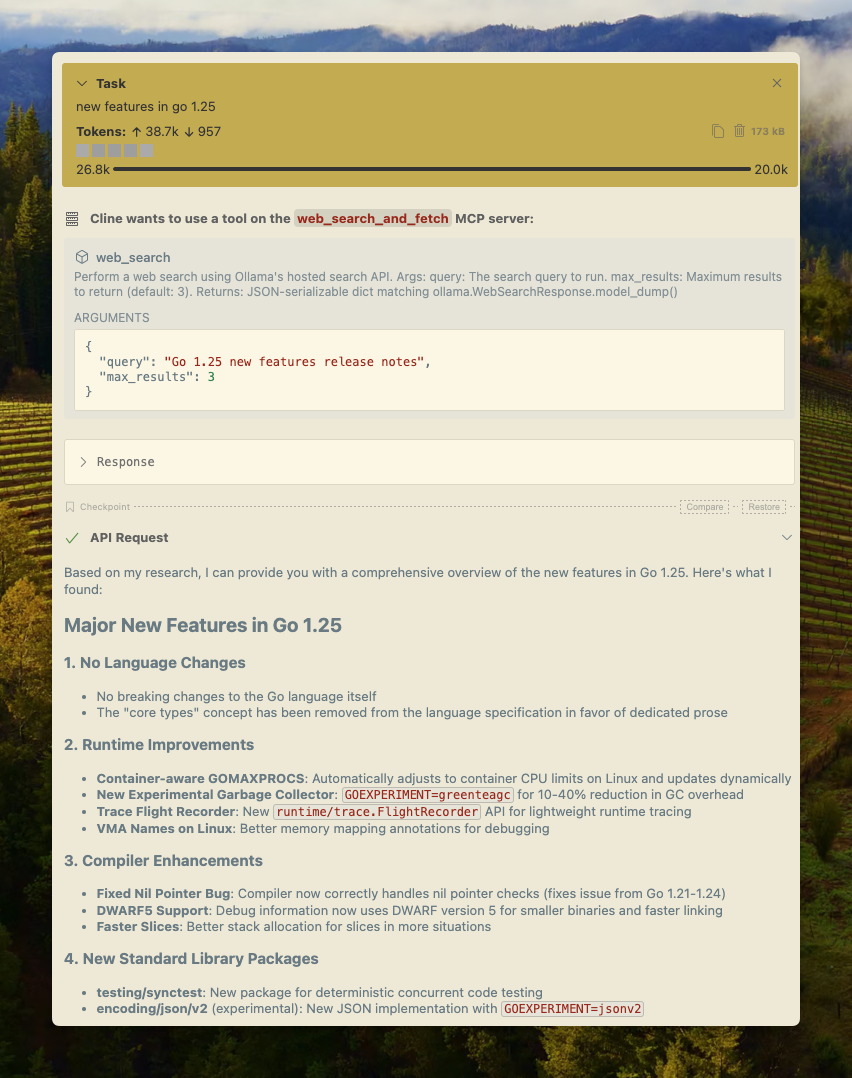
Cline
Ollama's web search can be integrated with Cline easily using the MCP server configuration.
Manage MCP Servers > Configure MCP Servers > Add the following configuration:
{
  "mcpServers": {
    "web_search_and_fetch": {
      "type": "stdio",
      "command": "uv",
      "args": ["run", "path/to/web-search-mcp.py"],
      "env": { "OLLAMA_API_KEY": "your_api_key_here" }
    }
  }
}
Codex
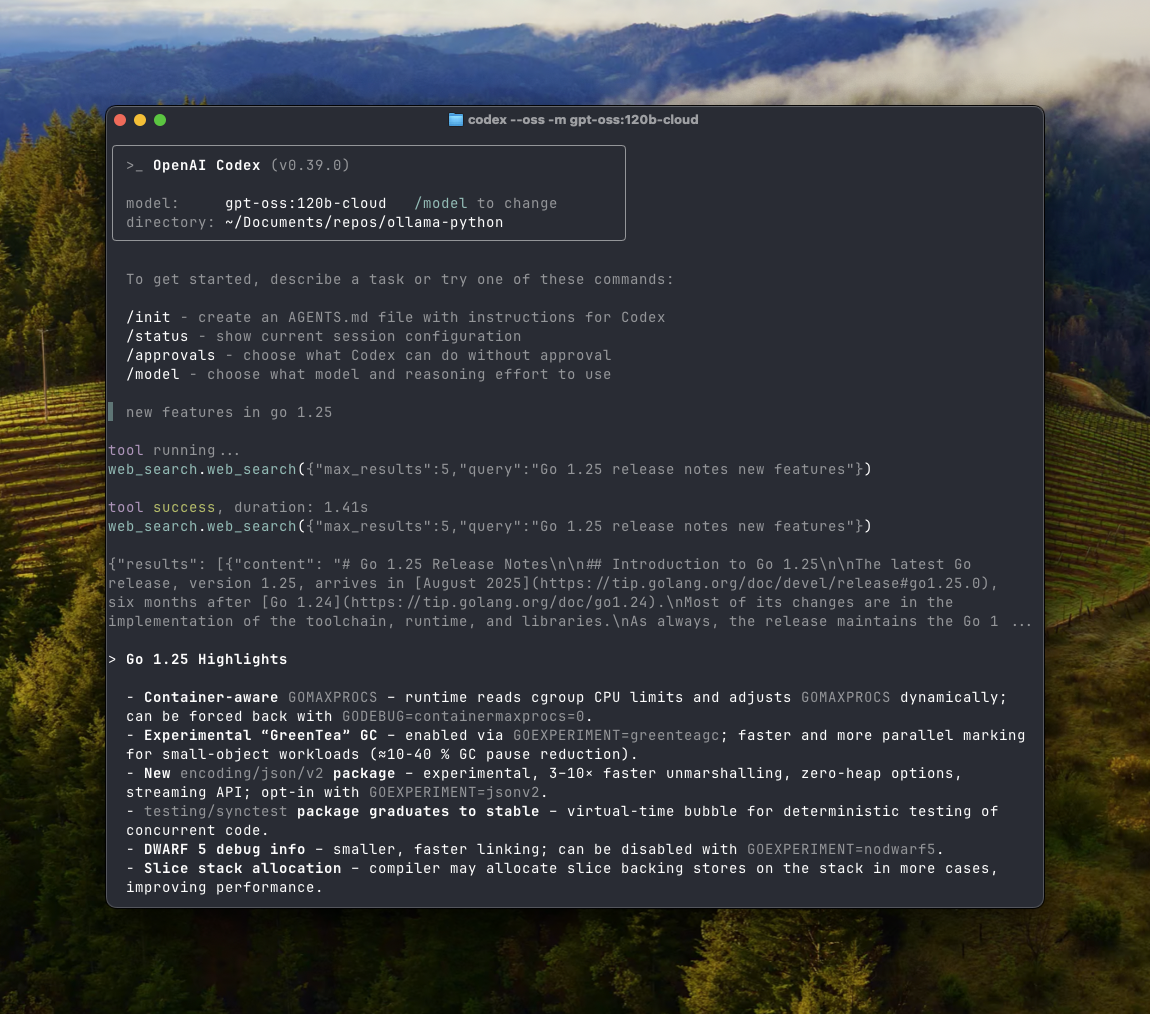
Ollama works well with OpenAI's Codex tool.
Add the following configuration to ~/.codex/config.toml
[mcp_servers.web_search]
command = "uv"
args = ["run", "path/to/web-search-mcp.py"]
env = { "OLLAMA_API_KEY" = "your_api_key_here" }
Goose
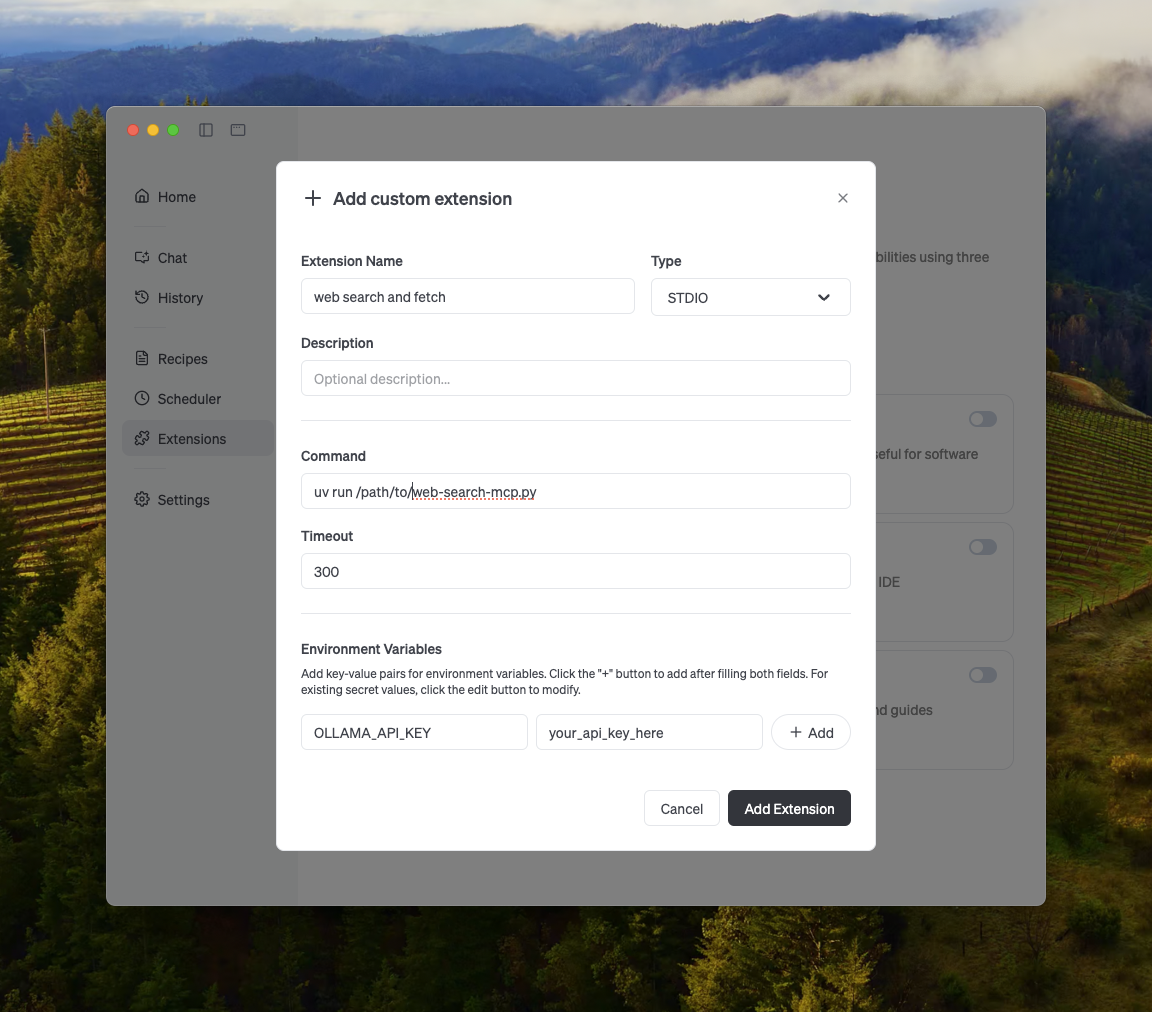
Ollama can integrate with Goose via its MCP feature.
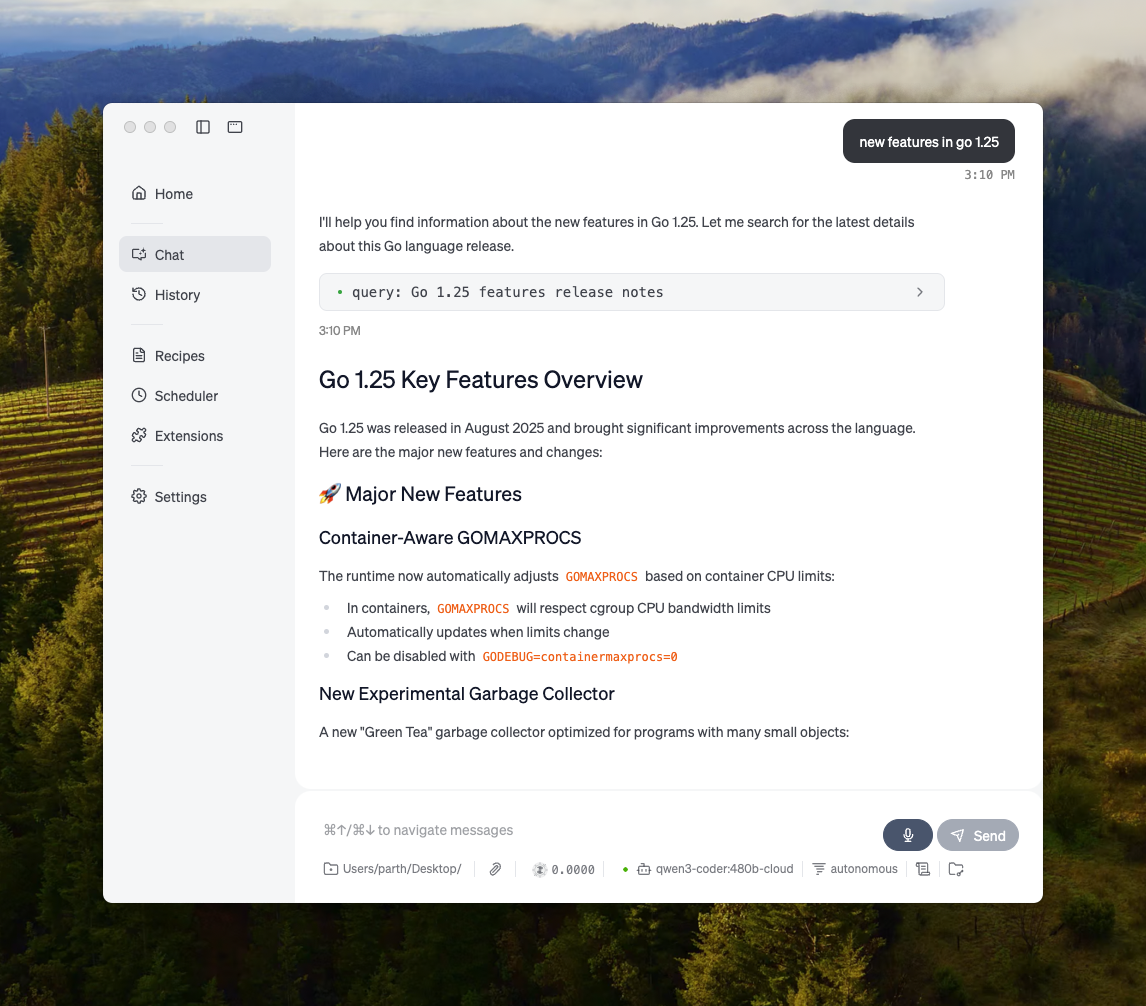
Other integrations
Ollama can be integrated into most of the tools available either through direct integration of Ollama's API, Python / JavaScript libraries, OpenAI compatible API, and MCP server integration.
CLI Reference
Source: https://docs.ollama.com/cli
Run a model
ollama run gemma3
Multiline input
For multiline input, you can wrap text with """:
>>> """Hello,
... world!
... """
I'm a basic program that prints the famous "Hello, world!" message to the console.
Multimodal models
ollama run gemma3 "What's in this image? /Users/jmorgan/Desktop/smile.png"
Download a model
ollama pull gemma3
Remove a model
ollama rm gemma3
List models
ollama ls
Sign in to Ollama
ollama signin
Sign out of Ollama
ollama signout
Create a customized model
First, create a Modelfile
FROM gemma3
SYSTEM """You are a happy cat."""
Then run ollama create:
ollama create -f Modelfile
List running models
ollama ps
Stop a running model
ollama stop gemma3
Start Ollama
ollama serve
To view a list of environment variables that can be set run ollama serve --help
Cloud
Source: https://docs.ollama.com/cloud
Ollama's cloud is currently in preview.
Cloud Models
Ollama's cloud models are a new kind of model in Ollama that can run without a powerful GPU. Instead, cloud models are automatically offloaded to Ollama's cloud service while offering the same capabilities as local models, making it possible to keep using your local tools while running larger models that wouldn't fit on a personal computer.
Ollama currently supports the following cloud models, with more coming soon:
deepseek-v3.1:671b-cloudgpt-oss:20b-cloudgpt-oss:120b-cloudkimi-k2:1t-cloudqwen3-coder:480b-cloudglm-4.6:cloudminimax-m2:cloud
Running Cloud models
Ollama's cloud models require an account on ollama.com. To sign in or create an account, run:
ollama signin
```
ollama run gpt-oss:120b-cloud
```
```
ollama pull gpt-oss:120b-cloud
```

Next, install [Ollama's Python library](https://github.com/ollama/ollama-python):

```
pip install ollama
```

Next, create and run a simple Python script:

```python  theme={"system"}
from ollama import Client

client = Client()

messages = [
  {
    'role': 'user',
    'content': 'Why is the sky blue?',
  },
]

for part in client.chat('gpt-oss:120b-cloud', messages=messages, stream=True):
  print(part['message']['content'], end='', flush=True)
```
```
ollama pull gpt-oss:120b-cloud
```

Next, install [Ollama's JavaScript library](https://github.com/ollama/ollama-js):

```
npm i ollama
```

Then use the library to run a cloud model:

```typescript  theme={"system"}
import { Ollama } from "ollama";

const ollama = new Ollama();

const response = await ollama.chat({
  model: "gpt-oss:120b-cloud",
  messages: [{ role: "user", content: "Explain quantum computing" }],
  stream: true,
});

for await (const part of response) {
  process.stdout.write(part.message.content);
}
```
```
ollama pull gpt-oss:120b-cloud
```

Run the following cURL command to run the command via Ollama's API:

```
curl http://localhost:11434/api/chat -d '{
  "model": "gpt-oss:120b-cloud",
  "messages": [{
    "role": "user",
    "content": "Why is the sky blue?"
  }],
  "stream": false
}'
```
Cloud API access
Cloud models can also be accessed directly on ollama.com's API. In this mode, ollama.com acts as a remote Ollama host.
Authentication
For direct access to ollama.com's API, first create an API key.
Then, set the OLLAMA_API_KEY environment variable to your API key.
export OLLAMA_API_KEY=your_api_key
Listing models
For models available directly via Ollama's API, models can be listed via:
curl https://ollama.com/api/tags
Generating a response
First, install [Ollama's Python library](https://github.com/ollama/ollama-python)```
pip install ollama
```
Then make a request
```python theme={"system"}
import os
from ollama import Client
client = Client(
host="https://ollama.com",
headers={'Authorization': 'Bearer ' + os.environ.get('OLLAMA_API_KEY')}
)
messages = [
{
'role': 'user',
'content': 'Why is the sky blue?',
},
]
for part in client.chat('gpt-oss:120b', messages=messages, stream=True):
print(part['message']['content'], end='', flush=True)
```
```
npm i ollama
```

Next, make a request to the model:

```typescript  theme={"system"}
import { Ollama } from "ollama";

const ollama = new Ollama({
  host: "https://ollama.com",
  headers: {
    Authorization: "Bearer " + process.env.OLLAMA_API_KEY,
  },
});

const response = await ollama.chat({
  model: "gpt-oss:120b",
  messages: [{ role: "user", content: "Explain quantum computing" }],
  stream: true,
});

for await (const part of response) {
  process.stdout.write(part.message.content);
}
```
```
curl https://ollama.com/api/chat \
  -H "Authorization: Bearer $OLLAMA_API_KEY" \
  -d '{
    "model": "gpt-oss:120b",
    "messages": [{
      "role": "user",
      "content": "Why is the sky blue?"
    }],
    "stream": false
  }'
```
Context length
Source: https://docs.ollama.com/context-length
Context length is the maximum number of tokens that the model has access to in memory.
The default context length in Ollama is 4096 tokens.Tasks which require large context like web search, agents, and coding tools should be set to at least 32000 tokens.
Setting context length
Setting a larger context length will increase the amount of memory required to run a model. Ensure you have enough VRAM available to increase the context length.
Cloud models are set to their maximum context length by default.
App
Change the slider in the Ollama app under settings to your desired context length.
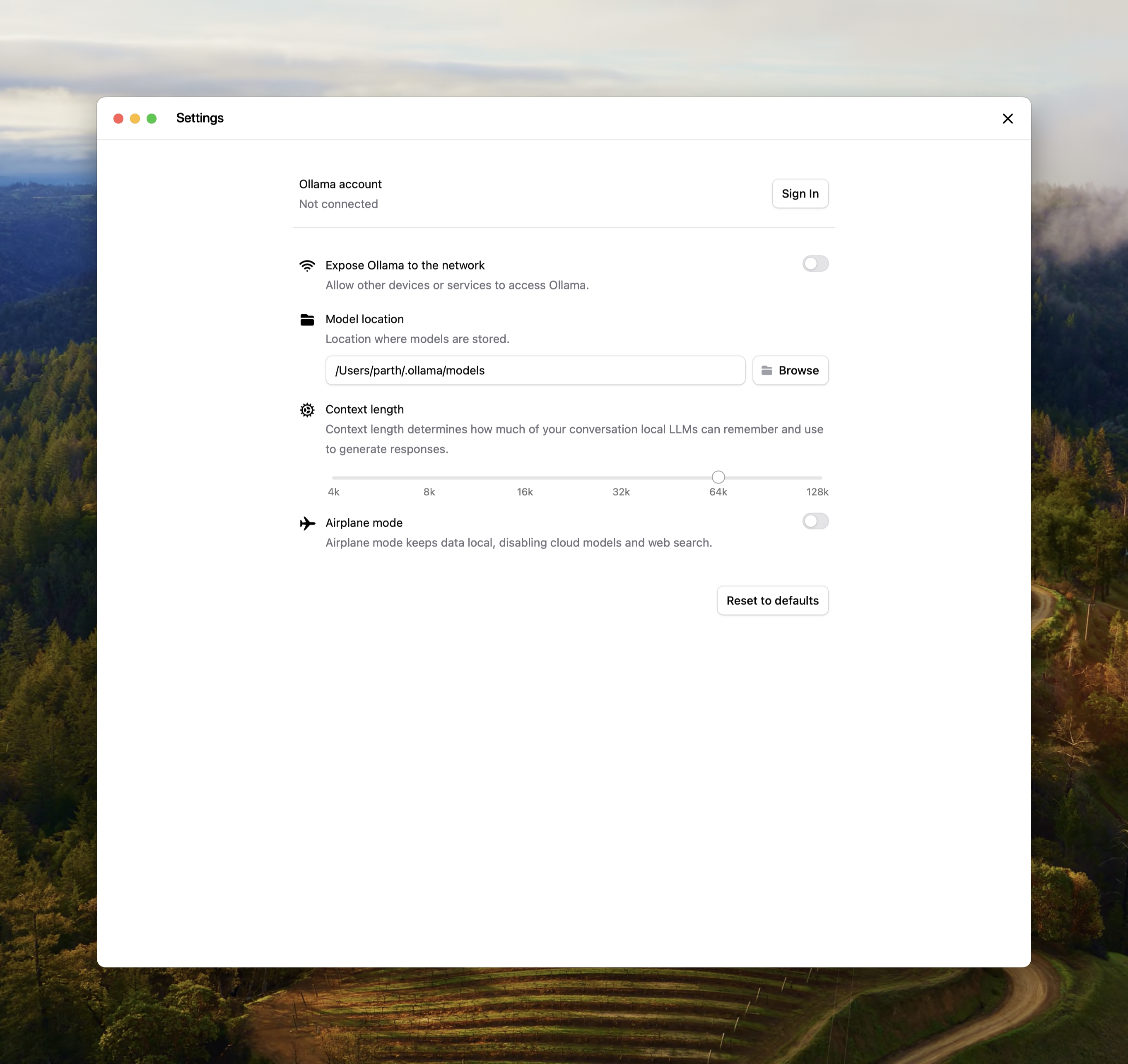
CLI
If editing the context length for Ollama is not possible, the context length can also be updated when serving Ollama.
OLLAMA_CONTEXT_LENGTH=32000 ollama serve
Check allocated context length and model offloading
For best performance, use the maximum context length for a model, and avoid offloading the model to CPU. Verify the split under PROCESSOR using ollama ps.
ollama ps
NAME             ID              SIZE      PROCESSOR    CONTEXT    UNTIL
gemma3:latest    a2af6cc3eb7f    6.6 GB    100% GPU     65536      2 minutes from now
null
Source: https://docs.ollama.com/docker
CPU only
docker run -d -v ollama:/root/.ollama -p 11434:11434 --name ollama ollama/ollama
Nvidia GPU
Install the NVIDIA Container Toolkit.
Install with Apt
-
Configure the repository
curl -fsSL https://nvidia.github.io/libnvidia-container/gpgkey \ | sudo gpg --dearmor -o /usr/share/keyrings/nvidia-container-toolkit-keyring.gpg curl -fsSL https://nvidia.github.io/libnvidia-container/stable/deb/nvidia-container-toolkit.list \ | sed 's#deb https://#deb [signed-by=/usr/share/keyrings/nvidia-container-toolkit-keyring.gpg] https://#g' \ | sudo tee /etc/apt/sources.list.d/nvidia-container-toolkit.list sudo apt-get update -
Install the NVIDIA Container Toolkit packages
sudo apt-get install -y nvidia-container-toolkit
Install with Yum or Dnf
-
Configure the repository
curl -fsSL https://nvidia.github.io/libnvidia-container/stable/rpm/nvidia-container-toolkit.repo \ | sudo tee /etc/yum.repos.d/nvidia-container-toolkit.repo -
Install the NVIDIA Container Toolkit packages
sudo yum install -y nvidia-container-toolkit
Configure Docker to use Nvidia driver
sudo nvidia-ctk runtime configure --runtime=docker
sudo systemctl restart docker
Start the container
docker run -d --gpus=all -v ollama:/root/.ollama -p 11434:11434 --name ollama ollama/ollama
AMD GPU
To run Ollama using Docker with AMD GPUs, use the rocm tag and the following command:
docker run -d --device /dev/kfd --device /dev/dri -v ollama:/root/.ollama -p 11434:11434 --name ollama ollama/ollama:rocm
Run model locally
Now you can run a model:
docker exec -it ollama ollama run llama3.2
Try different models
More models can be found on the Ollama library.
FAQ
Source: https://docs.ollama.com/faq
How can I upgrade Ollama?
Ollama on macOS and Windows will automatically download updates. Click on the taskbar or menubar item and then click "Restart to update" to apply the update. Updates can also be installed by downloading the latest version manually.
On Linux, re-run the install script:
curl -fsSL https://ollama.com/install.sh | sh
How can I view the logs?
Review the Troubleshooting docs for more about using logs.
Is my GPU compatible with Ollama?
Please refer to the GPU docs.
How can I specify the context window size?
By default, Ollama uses a context window size of 2048 tokens.
This can be overridden with the OLLAMA_CONTEXT_LENGTH environment variable. For example, to set the default context window to 8K, use:
OLLAMA_CONTEXT_LENGTH=8192 ollama serve
To change this when using ollama run, use /set parameter:
/set parameter num_ctx 4096
When using the API, specify the num_ctx parameter:
curl http://localhost:11434/api/generate -d '{
  "model": "llama3.2",
  "prompt": "Why is the sky blue?",
  "options": {
    "num_ctx": 4096
  }
}'
How can I tell if my model was loaded onto the GPU?
Use the ollama ps command to see what models are currently loaded into memory.
ollama ps
The Processor column will show which memory the model was loaded in to:
100% GPUmeans the model was loaded entirely into the GPU100% CPUmeans the model was loaded entirely in system memory48%/52% CPU/GPUmeans the model was loaded partially onto both the GPU and into system memory
How do I configure Ollama server?
Ollama server can be configured with environment variables.
Setting environment variables on Mac
If Ollama is run as a macOS application, environment variables should be set using launchctl:
-
For each environment variable, call
launchctl setenv.launchctl setenv OLLAMA_HOST "0.0.0.0:11434" -
Restart Ollama application.
Setting environment variables on Linux
If Ollama is run as a systemd service, environment variables should be set using systemctl:
-
Edit the systemd service by calling
systemctl edit ollama.service. This will open an editor. -
For each environment variable, add a line
Environmentunder section[Service]:[Service] Environment="OLLAMA_HOST=0.0.0.0:11434" -
Save and exit.
-
Reload
systemdand restart Ollama:systemctl daemon-reload systemctl restart ollama
Setting environment variables on Windows
On Windows, Ollama inherits your user and system environment variables.
-
First Quit Ollama by clicking on it in the task bar.
-
Start the Settings (Windows 11) or Control Panel (Windows 10) application and search for environment variables.
-
Click on Edit environment variables for your account.
-
Edit or create a new variable for your user account for
OLLAMA_HOST,OLLAMA_MODELS, etc. -
Click OK/Apply to save.
-
Start the Ollama application from the Windows Start menu.
How do I use Ollama behind a proxy?
Ollama pulls models from the Internet and may require a proxy server to access the models. Use HTTPS_PROXY to redirect outbound requests through the proxy. Ensure the proxy certificate is installed as a system certificate. Refer to the section above for how to use environment variables on your platform.
How do I use Ollama behind a proxy in Docker?
The Ollama Docker container image can be configured to use a proxy by passing -e HTTPS_PROXY=https://proxy.example.com when starting the container.
Alternatively, the Docker daemon can be configured to use a proxy. Instructions are available for Docker Desktop on macOS, Windows, and Linux, and Docker daemon with systemd.
Ensure the certificate is installed as a system certificate when using HTTPS. This may require a new Docker image when using a self-signed certificate.
FROM ollama/ollama
COPY my-ca.pem /usr/local/share/ca-certificates/my-ca.crt
RUN update-ca-certificates
Build and run this image:
docker build -t ollama-with-ca .
docker run -d -e HTTPS_PROXY=https://my.proxy.example.com -p 11434:11434 ollama-with-ca
Does Ollama send my prompts and answers back to ollama.com?
No. Ollama runs locally, and conversation data does not leave your machine.
How can I expose Ollama on my network?
Ollama binds 127.0.0.1 port 11434 by default. Change the bind address with the OLLAMA_HOST environment variable.
Refer to the section above for how to set environment variables on your platform.
How can I use Ollama with a proxy server?
Ollama runs an HTTP server and can be exposed using a proxy server such as Nginx. To do so, configure the proxy to forward requests and optionally set required headers (if not exposing Ollama on the network). For example, with Nginx:
server {
    listen 80;
    server_name example.com;  # Replace with your domain or IP
    location / {
        proxy_pass http://localhost:11434;
        proxy_set_header Host localhost:11434;
    }
}
How can I use Ollama with ngrok?
Ollama can be accessed using a range of tools for tunneling tools. For example with Ngrok:
ngrok http 11434 --host-header="localhost:11434"
How can I use Ollama with Cloudflare Tunnel?
To use Ollama with Cloudflare Tunnel, use the --url and --http-host-header flags:
cloudflared tunnel --url http://localhost:11434 --http-host-header="localhost:11434"
How can I allow additional web origins to access Ollama?
Ollama allows cross-origin requests from 127.0.0.1 and 0.0.0.0 by default. Additional origins can be configured with OLLAMA_ORIGINS.
For browser extensions, you'll need to explicitly allow the extension's origin pattern. Set OLLAMA_ORIGINS to include chrome-extension://*, moz-extension://*, and safari-web-extension://* if you wish to allow all browser extensions access, or specific extensions as needed:
# Allow all Chrome, Firefox, and Safari extensions
OLLAMA_ORIGINS=chrome-extension://*,moz-extension://*,safari-web-extension://* ollama serve
Refer to the section above for how to set environment variables on your platform.
Where are models stored?
- macOS:
~/.ollama/models - Linux:
/usr/share/ollama/.ollama/models - Windows:
C:\Users\%username%\.ollama\models
How do I set them to a different location?
If a different directory needs to be used, set the environment variable OLLAMA_MODELS to the chosen directory.
Refer to the section above for how to set environment variables on your platform.
How can I use Ollama in Visual Studio Code?
There is already a large collection of plugins available for VSCode as well as other editors that leverage Ollama. See the list of extensions & plugins at the bottom of the main repository readme.
How do I use Ollama with GPU acceleration in Docker?
The Ollama Docker container can be configured with GPU acceleration in Linux or Windows (with WSL2). This requires the nvidia-container-toolkit. See ollama/ollama for more details.
GPU acceleration is not available for Docker Desktop in macOS due to the lack of GPU passthrough and emulation.
Why is networking slow in WSL2 on Windows 10?
This can impact both installing Ollama, as well as downloading models.
Open Control Panel > Networking and Internet > View network status and tasks and click on Change adapter settings on the left panel. Find the vEthernel (WSL) adapter, right click and select Properties.
Click on Configure and open the Advanced tab. Search through each of the properties until you find Large Send Offload Version 2 (IPv4) and Large Send Offload Version 2 (IPv6). Disable both of these
properties.
How can I preload a model into Ollama to get faster response times?
If you are using the API you can preload a model by sending the Ollama server an empty request. This works with both the /api/generate and /api/chat API endpoints.
To preload the mistral model using the generate endpoint, use:
curl http://localhost:11434/api/generate -d '{"model": "mistral"}'
To use the chat completions endpoint, use:
curl http://localhost:11434/api/chat -d '{"model": "mistral"}'
To preload a model using the CLI, use the command:
ollama run llama3.2 ""
How do I keep a model loaded in memory or make it unload immediately?
By default models are kept in memory for 5 minutes before being unloaded. This allows for quicker response times if you're making numerous requests to the LLM. If you want to immediately unload a model from memory, use the ollama stop command:
ollama stop llama3.2
If you're using the API, use the keep_alive parameter with the /api/generate and /api/chat endpoints to set the amount of time that a model stays in memory. The keep_alive parameter can be set to:
- a duration string (such as "10m" or "24h")
- a number in seconds (such as 3600)
- any negative number which will keep the model loaded in memory (e.g. -1 or "-1m")
- '0' which will unload the model immediately after generating a response
For example, to preload a model and leave it in memory use:
curl http://localhost:11434/api/generate -d '{"model": "llama3.2", "keep_alive": -1}'
To unload the model and free up memory use:
curl http://localhost:11434/api/generate -d '{"model": "llama3.2", "keep_alive": 0}'
Alternatively, you can change the amount of time all models are loaded into memory by setting the OLLAMA_KEEP_ALIVE environment variable when starting the Ollama server. The OLLAMA_KEEP_ALIVE variable uses the same parameter types as the keep_alive parameter types mentioned above. Refer to the section explaining how to configure the Ollama server to correctly set the environment variable.
The keep_alive API parameter with the /api/generate and /api/chat API endpoints will override the OLLAMA_KEEP_ALIVE setting.
How do I manage the maximum number of requests the Ollama server can queue?
If too many requests are sent to the server, it will respond with a 503 error indicating the server is overloaded. You can adjust how many requests may be queue by setting OLLAMA_MAX_QUEUE.
How does Ollama handle concurrent requests?
Ollama supports two levels of concurrent processing. If your system has sufficient available memory (system memory when using CPU inference, or VRAM for GPU inference) then multiple models can be loaded at the same time. For a given model, if there is sufficient available memory when the model is loaded, it is configured to allow parallel request processing.
If there is insufficient available memory to load a new model request while one or more models are already loaded, all new requests will be queued until the new model can be loaded. As prior models become idle, one or more will be unloaded to make room for the new model. Queued requests will be processed in order. When using GPU inference new models must be able to completely fit in VRAM to allow concurrent model loads.
Parallel request processing for a given model results in increasing the context size by the number of parallel requests. For example, a 2K context with 4 parallel requests will result in an 8K context and additional memory allocation.
The following server settings may be used to adjust how Ollama handles concurrent requests on most platforms:
OLLAMA_MAX_LOADED_MODELS- The maximum number of models that can be loaded concurrently provided they fit in available memory. The default is 3 * the number of GPUs or 3 for CPU inference.OLLAMA_NUM_PARALLEL- The maximum number of parallel requests each model will process at the same time. The default will auto-select either 4 or 1 based on available memory.OLLAMA_MAX_QUEUE- The maximum number of requests Ollama will queue when busy before rejecting additional requests. The default is 512
Note: Windows with Radeon GPUs currently default to 1 model maximum due to limitations in ROCm v5.7 for available VRAM reporting. Once ROCm v6.2 is available, Windows Radeon will follow the defaults above. You may enable concurrent model loads on Radeon on Windows, but ensure you don't load more models than will fit into your GPUs VRAM.
How does Ollama load models on multiple GPUs?
When loading a new model, Ollama evaluates the required VRAM for the model against what is currently available. If the model will entirely fit on any single GPU, Ollama will load the model on that GPU. This typically provides the best performance as it reduces the amount of data transferring across the PCI bus during inference. If the model does not fit entirely on one GPU, then it will be spread across all the available GPUs.
How can I enable Flash Attention?
Flash Attention is a feature of most modern models that can significantly reduce memory usage as the context size grows. To enable Flash Attention, set the OLLAMA_FLASH_ATTENTION environment variable to 1 when starting the Ollama server.
How can I set the quantization type for the K/V cache?
The K/V context cache can be quantized to significantly reduce memory usage when Flash Attention is enabled.
To use quantized K/V cache with Ollama you can set the following environment variable:
OLLAMA_KV_CACHE_TYPE- The quantization type for the K/V cache. Default isf16.
The currently available K/V cache quantization types are:
f16- high precision and memory usage (default).q8_0- 8-bit quantization, uses approximately 1/2 the memory off16with a very small loss in precision, this usually has no noticeable impact on the model's quality (recommended if not using f16).q4_0- 4-bit quantization, uses approximately 1/4 the memory off16with a small-medium loss in precision that may be more noticeable at higher context sizes.
How much the cache quantization impacts the model's response quality will depend on the model and the task. Models that have a high GQA count (e.g. Qwen2) may see a larger impact on precision from quantization than models with a low GQA count.
You may need to experiment with different quantization types to find the best balance between memory usage and quality.
Where can I find my Ollama Public Key?
Your Ollama Public Key is the public part of the key pair that lets your local Ollama instance talk to ollama.com.
You'll need it to:
- Push models to Ollama
- Pull private models from Ollama to your machine
- Run models hosted in Ollama Cloud
How to Add the Key
-
Sign-in via the Settings page in the Mac and Windows App
-
Sign‑in via CLI
ollama signin
- Manually copy & paste the key on the Ollama Keys page: https://ollama.com/settings/keys
Where the Ollama Public Key lives
| OS | Path to id_ed25519.pub |
|---|---|
| macOS | ~/.ollama/id_ed25519.pub |
| Linux | /usr/share/ollama/.ollama/id_ed25519.pub |
| Windows | C:\Users\<username>\.ollama\id_ed25519.pub |
Hardware support
Source: https://docs.ollama.com/gpu
Nvidia
Ollama supports Nvidia GPUs with compute capability 5.0+.
Check your compute compatibility to see if your card is supported: https://developer.nvidia.com/cuda-gpus
| Compute Capability | Family | Cards |
|---|---|---|
| 9.0 | NVIDIA | H200 H100 |
| 8.9 | GeForce RTX 40xx | RTX 4090 RTX 4080 SUPER RTX 4080 RTX 4070 Ti SUPER RTX 4070 Ti RTX 4070 SUPER RTX 4070 RTX 4060 Ti RTX 4060 |
| NVIDIA Professional | L4 L40 RTX 6000 |
|
| 8.6 | GeForce RTX 30xx | RTX 3090 Ti RTX 3090 RTX 3080 Ti RTX 3080 RTX 3070 Ti RTX 3070 RTX 3060 Ti RTX 3060 RTX 3050 Ti RTX 3050 |
| NVIDIA Professional | A40 RTX A6000 RTX A5000 RTX A4000 RTX A3000 RTX A2000 A10 A16 A2 |
|
| 8.0 | NVIDIA | A100 A30 |
| 7.5 | GeForce GTX/RTX | GTX 1650 Ti TITAN RTX RTX 2080 Ti RTX 2080 RTX 2070 RTX 2060 |
| NVIDIA Professional | T4 RTX 5000 RTX 4000 RTX 3000 T2000 T1200 T1000 T600 T500 |
|
| Quadro | RTX 8000 RTX 6000 RTX 5000 RTX 4000 |
|
| 7.0 | NVIDIA | TITAN V V100 Quadro GV100 |
| 6.1 | NVIDIA TITAN | TITAN Xp TITAN X |
| GeForce GTX | GTX 1080 Ti GTX 1080 GTX 1070 Ti GTX 1070 GTX 1060 GTX 1050 Ti GTX 1050 |
|
| Quadro | P6000 P5200 P4200 P3200 P5000 P4000 P3000 P2200 P2000 P1000 P620 P600 P500 P520 |
|
| Tesla | P40 P4 |
|
| 6.0 | NVIDIA | Tesla P100 Quadro GP100 |
| 5.2 | GeForce GTX | GTX TITAN X GTX 980 Ti GTX 980 GTX 970 GTX 960 GTX 950 |
| Quadro | M6000 24GB M6000 M5000 M5500M M4000 M2200 M2000 M620 |
|
| Tesla | M60 M40 |
|
| 5.0 | GeForce GTX | GTX 750 Ti GTX 750 NVS 810 |
| Quadro | K2200 K1200 K620 M1200 M520 M5000M M4000M M3000M M2000M M1000M K620M M600M M500M |
For building locally to support older GPUs, see developer.md
GPU Selection
If you have multiple NVIDIA GPUs in your system and want to limit Ollama to use
a subset, you can set CUDA_VISIBLE_DEVICES to a comma separated list of GPUs.
Numeric IDs may be used, however ordering may vary, so UUIDs are more reliable.
You can discover the UUID of your GPUs by running nvidia-smi -L If you want to
ignore the GPUs and force CPU usage, use an invalid GPU ID (e.g., "-1")
Linux Suspend Resume
On linux, after a suspend/resume cycle, sometimes Ollama will fail to discover
your NVIDIA GPU, and fallback to running on the CPU. You can workaround this
driver bug by reloading the NVIDIA UVM driver with sudo rmmod nvidia_uvm && sudo modprobe nvidia_uvm
AMD Radeon
Ollama supports the following AMD GPUs:
Linux Support
| Family | Cards and accelerators |
|---|---|
| AMD Radeon RX | 7900 XTX 7900 XT 7900 GRE 7800 XT 7700 XT 7600 XT 7600 6950 XT 6900 XTX 6900XT 6800 XT 6800 Vega 64 Vega 56 |
| AMD Radeon PRO | W7900 W7800 W7700 W7600 W7500 W6900X W6800X Duo W6800X W6800 V620 V420 V340 V320 Vega II Duo Vega II VII SSG |
| AMD Instinct | MI300X MI300A MI300 MI250X MI250 MI210 MI200 MI100 MI60 MI50 |
Windows Support
With ROCm v6.1, the following GPUs are supported on Windows.
| Family | Cards and accelerators |
|---|---|
| AMD Radeon RX | 7900 XTX 7900 XT 7900 GRE 7800 XT 7700 XT 7600 XT 7600 6950 XT 6900 XTX 6900XT 6800 XT 6800 |
| AMD Radeon PRO | W7900 W7800 W7700 W7600 W7500 W6900X W6800X Duo W6800X W6800 V620 |
Overrides on Linux
Ollama leverages the AMD ROCm library, which does not support all AMD GPUs. In
some cases you can force the system to try to use a similar LLVM target that is
close. For example The Radeon RX 5400 is gfx1034 (also known as 10.3.4)
however, ROCm does not currently support this target. The closest support is
gfx1030. You can use the environment variable HSA_OVERRIDE_GFX_VERSION with
x.y.z syntax. So for example, to force the system to run on the RX 5400, you
would set HSA_OVERRIDE_GFX_VERSION="10.3.0" as an environment variable for the
server. If you have an unsupported AMD GPU you can experiment using the list of
supported types below.
If you have multiple GPUs with different GFX versions, append the numeric device
number to the environment variable to set them individually. For example,
HSA_OVERRIDE_GFX_VERSION_0=10.3.0 and HSA_OVERRIDE_GFX_VERSION_1=11.0.0
At this time, the known supported GPU types on linux are the following LLVM Targets. This table shows some example GPUs that map to these LLVM targets:
| LLVM Target | An Example GPU |
|---|---|
| gfx900 | Radeon RX Vega 56 |
| gfx906 | Radeon Instinct MI50 |
| gfx908 | Radeon Instinct MI100 |
| gfx90a | Radeon Instinct MI210 |
| gfx940 | Radeon Instinct MI300 |
| gfx941 | |
| gfx942 | |
| gfx1030 | Radeon PRO V620 |
| gfx1100 | Radeon PRO W7900 |
| gfx1101 | Radeon PRO W7700 |
| gfx1102 | Radeon RX 7600 |
AMD is working on enhancing ROCm v6 to broaden support for families of GPUs in a future release which should increase support for more GPUs.
Reach out on Discord or file an issue for additional help.
GPU Selection
If you have multiple AMD GPUs in your system and want to limit Ollama to use a
subset, you can set ROCR_VISIBLE_DEVICES to a comma separated list of GPUs.
You can see the list of devices with rocminfo. If you want to ignore the GPUs
and force CPU usage, use an invalid GPU ID (e.g., "-1"). When available, use the
Uuid to uniquely identify the device instead of numeric value.
Container Permission
In some Linux distributions, SELinux can prevent containers from
accessing the AMD GPU devices. On the host system you can run
sudo setsebool container_use_devices=1 to allow containers to use devices.
Metal (Apple GPUs)
Ollama supports GPU acceleration on Apple devices via the Metal API.
Importing a Model
Source: https://docs.ollama.com/import
Table of Contents
- Importing a Safetensors adapter
- Importing a Safetensors model
- Importing a GGUF file
- Sharing models on ollama.com
Importing a fine tuned adapter from Safetensors weights
First, create a Modelfile with a FROM command pointing at the base model you used for fine tuning, and an ADAPTER command which points to the directory with your Safetensors adapter:
FROM <base model name>
ADAPTER /path/to/safetensors/adapter/directory
Make sure that you use the same base model in the FROM command as you used to create the adapter otherwise you will get erratic results. Most frameworks use different quantization methods, so it's best to use non-quantized (i.e. non-QLoRA) adapters. If your adapter is in the same directory as your Modelfile, use ADAPTER . to specify the adapter path.
Now run ollama create from the directory where the Modelfile was created:
ollama create my-model
Lastly, test the model:
ollama run my-model
Ollama supports importing adapters based on several different model architectures including:
- Llama (including Llama 2, Llama 3, Llama 3.1, and Llama 3.2);
- Mistral (including Mistral 1, Mistral 2, and Mixtral); and
- Gemma (including Gemma 1 and Gemma 2)
You can create the adapter using a fine tuning framework or tool which can output adapters in the Safetensors format, such as:
- Hugging Face fine tuning framework
- Unsloth
- MLX
Importing a model from Safetensors weights
First, create a Modelfile with a FROM command which points to the directory containing your Safetensors weights:
FROM /path/to/safetensors/directory
If you create the Modelfile in the same directory as the weights, you can use the command FROM ..
Now run the ollama create command from the directory where you created the Modelfile:
ollama create my-model
Lastly, test the model:
ollama run my-model
Ollama supports importing models for several different architectures including:
- Llama (including Llama 2, Llama 3, Llama 3.1, and Llama 3.2);
- Mistral (including Mistral 1, Mistral 2, and Mixtral);
- Gemma (including Gemma 1 and Gemma 2); and
- Phi3
This includes importing foundation models as well as any fine tuned models which have been fused with a foundation model.
Importing a GGUF based model or adapter
If you have a GGUF based model or adapter it is possible to import it into Ollama. You can obtain a GGUF model or adapter by:
- converting a Safetensors model with the
convert_hf_to_gguf.pyfrom Llama.cpp; - converting a Safetensors adapter with the
convert_lora_to_gguf.pyfrom Llama.cpp; or - downloading a model or adapter from a place such as HuggingFace
To import a GGUF model, create a Modelfile containing:
FROM /path/to/file.gguf
For a GGUF adapter, create the Modelfile with:
FROM <model name>
ADAPTER /path/to/file.gguf
When importing a GGUF adapter, it's important to use the same base model as the base model that the adapter was created with. You can use:
- a model from Ollama
- a GGUF file
- a Safetensors based model
Once you have created your Modelfile, use the ollama create command to build the model.
ollama create my-model
Quantizing a Model
Quantizing a model allows you to run models faster and with less memory consumption but at reduced accuracy. This allows you to run a model on more modest hardware.
Ollama can quantize FP16 and FP32 based models into different quantization levels using the -q/--quantize flag with the ollama create command.
First, create a Modelfile with the FP16 or FP32 based model you wish to quantize.
FROM /path/to/my/gemma/f16/model
Use ollama create to then create the quantized model.
$ ollama create --quantize q4_K_M mymodel
transferring model data
quantizing F16 model to Q4_K_M
creating new layer sha256:735e246cc1abfd06e9cdcf95504d6789a6cd1ad7577108a70d9902fef503c1bd
creating new layer sha256:0853f0ad24e5865173bbf9ffcc7b0f5d56b66fd690ab1009867e45e7d2c4db0f
writing manifest
success
Supported Quantizations
q4_0q4_1q5_0q5_1q8_0
K-means Quantizations
q3_K_Sq3_K_Mq3_K_Lq4_K_Sq4_K_Mq5_K_Sq5_K_Mq6_K
Sharing your model on ollama.com
You can share any model you have created by pushing it to ollama.com so that other users can try it out.
First, use your browser to go to the Ollama Sign-Up page. If you already have an account, you can skip this step.
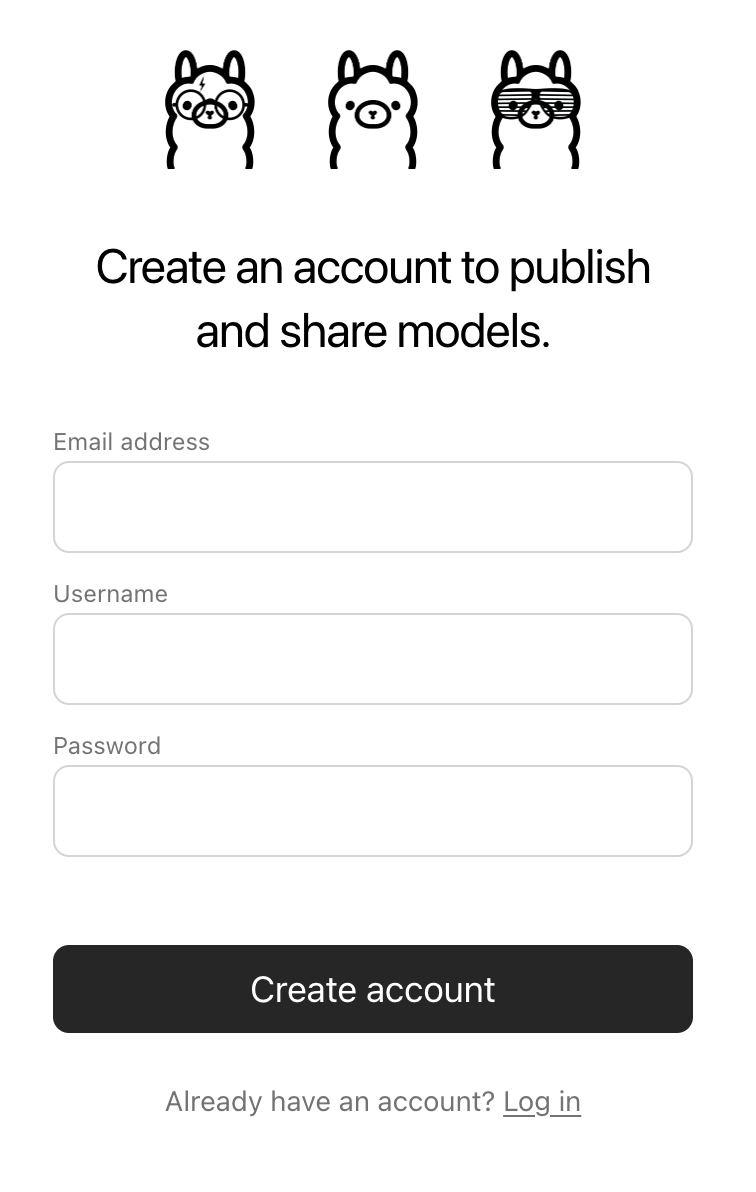
The Username field will be used as part of your model's name (e.g. jmorganca/mymodel), so make sure you are comfortable with the username that you have selected.
Now that you have created an account and are signed-in, go to the Ollama Keys Settings page.
Follow the directions on the page to determine where your Ollama Public Key is located.
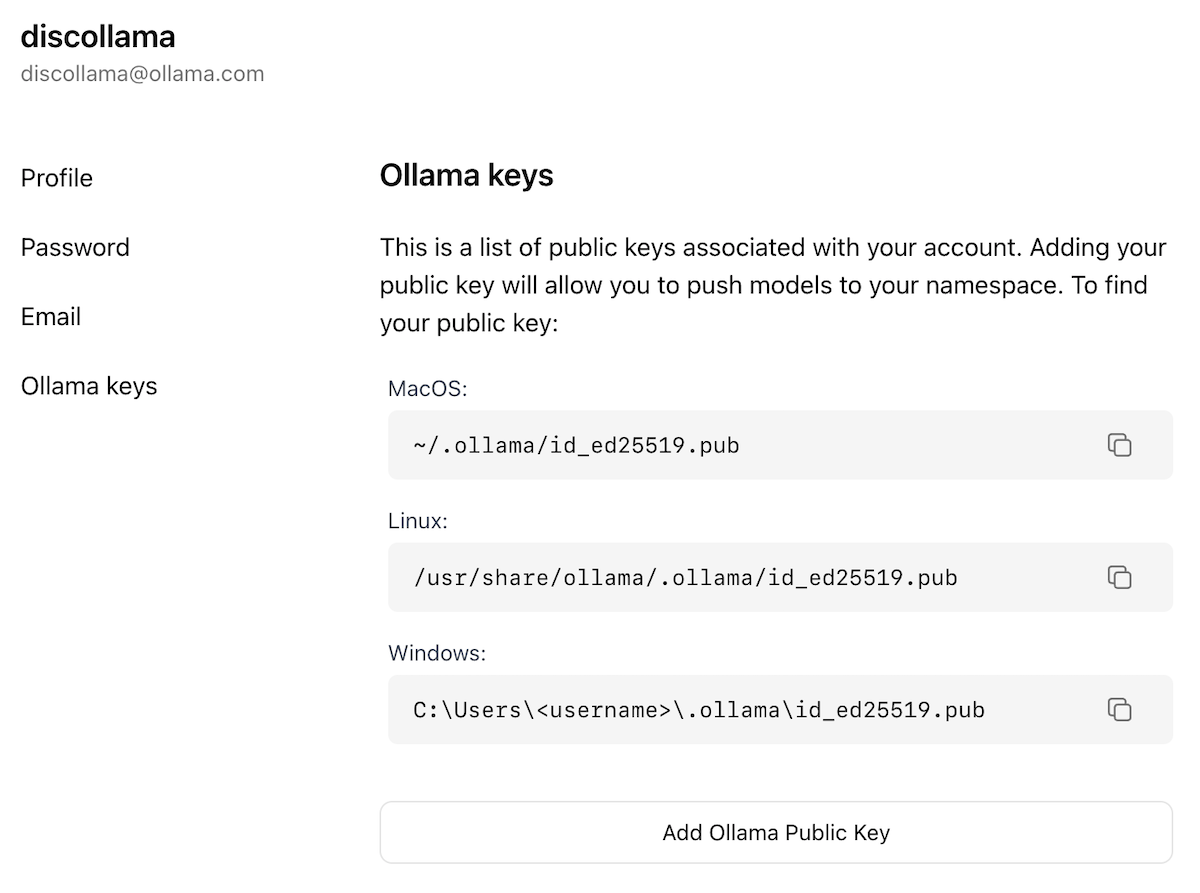
Click on the Add Ollama Public Key button, and copy and paste the contents of your Ollama Public Key into the text field.
To push a model to ollama.com, first make sure that it is named correctly with your username. You may have to use the ollama cp command to copy
your model to give it the correct name. Once you're happy with your model's name, use the ollama push command to push it to ollama.com.
ollama cp mymodel myuser/mymodel
ollama push myuser/mymodel
Once your model has been pushed, other users can pull and run it by using the command:
ollama run myuser/mymodel
Ollama's documentation
Source: https://docs.ollama.com/index

Ollama is the easiest way to get up and running with large language models such as gpt-oss, Gemma 3, DeepSeek-R1, Qwen3 and more.
Get up and running with your first model Download Ollama on macOS, Windows or Linux Ollama's cloud models offer larger models with better performance. View Ollama's API referenceLibraries
The official library for using Ollama with Python The official library for using Ollama with JavaScript or TypeScript. View a list of 20+ community-supported libraries for OllamaCommunity
Join our Discord community Join our Reddit communityCline
Source: https://docs.ollama.com/integrations/cline
Install
Install Cline in your IDE.
Usage with Ollama
- Open Cline settings >
API Configurationand setAPI ProvidertoOllama - Select a model under
Modelor type one (e.g.qwen3) - Update the context window to at least 32K tokens under
Context Window
Coding tools require a larger context window. It is recommended to use a context window of at least 32K tokens. See Context length for more information.
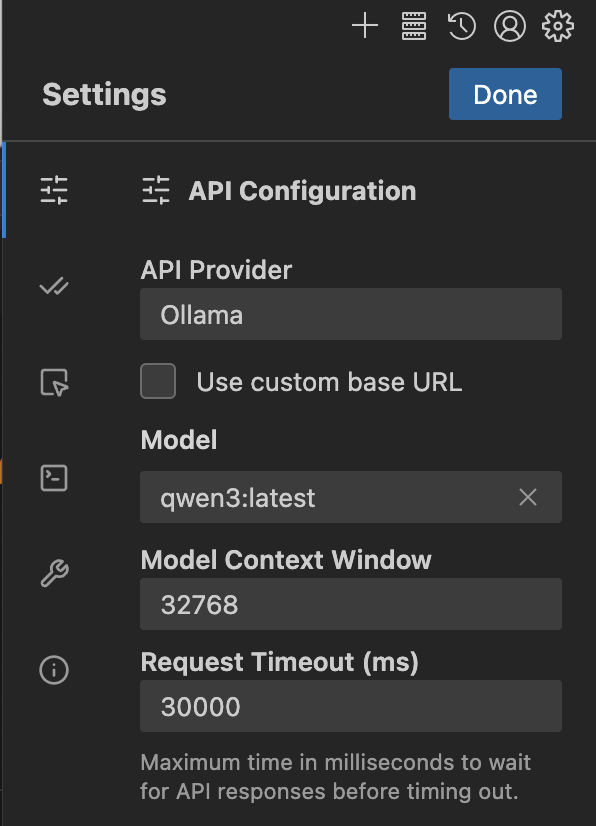
Connecting to ollama.com
- Create an API key from ollama.com
- Click on
Use custom base URLand set it tohttps://ollama.com - Enter your Ollama API Key
- Select a model from the list
Recommended Models
qwen3-coder:480bdeepseek-v3.1:671b
Codex
Source: https://docs.ollama.com/integrations/codex
Install
Install the Codex CLI:
npm install -g @openai/codex
Usage with Ollama
Codex requires a larger context window. It is recommended to use a context window of at least 32K tokens.
To use codex with Ollama, use the --oss flag:
codex --oss
Changing Models
By default, codex will use the local gpt-oss:20b model. However, you can specify a different model with the -m flag:
codex --oss -m gpt-oss:120b
Cloud Models
codex --oss -m gpt-oss:120b-cloud
Connecting to ollama.com
Create an API key from ollama.com and export it as OLLAMA_API_KEY.
To use ollama.com directly, edit your ~/.codex/config.toml file to point to ollama.com.
model = "gpt-oss:120b"
model_provider = "ollama"

[model_providers.ollama]
name = "Ollama"
base_url = "https://ollama.com/v1"
env_key = "OLLAMA_API_KEY"
Run codex in a new terminal to load the new settings.
Droid
Source: https://docs.ollama.com/integrations/droid
Install
Install the Droid CLI:
curl -fsSL https://app.factory.ai/cli | sh
Droid requires a larger context window. It is recommended to use a context window of at least 32K tokens. See Context length for more information.
Usage with Ollama
Add a local configuration block to ~/.factory/config.json:
{
  "custom_models": [
    {
      "model_display_name": "qwen3-coder [Ollama]",
      "model": "qwen3-coder",
      "base_url": "http://localhost:11434/v1/",
      "api_key": "not-needed",
      "provider": "generic-chat-completion-api",
      "max_tokens": 32000
    }
  ]
}
Cloud Models
qwen3-coder:480b-cloud is the recommended model for use with Droid.
Add the cloud configuration block to ~/.factory/config.json:
{
  "custom_models": [
    {
      "model_display_name": "qwen3-coder [Ollama Cloud]",
      "model": "qwen3-coder:480b-cloud",
      "base_url": "http://localhost:11434/v1/",
      "api_key": "not-needed",
      "provider": "generic-chat-completion-api",
      "max_tokens": 128000
    }
  ]
}
Connecting to ollama.com
-
Create an API key from ollama.com and export it as
OLLAMA_API_KEY. -
Add the cloud configuration block to
~/.factory/config.json:{ "custom_models": [ { "model_display_name": "qwen3-coder [Ollama Cloud]", "model": "qwen3-coder:480b", "base_url": "https://ollama.com/v1/", "api_key": "OLLAMA_API_KEY", "provider": "generic-chat-completion-api", "max_tokens": 128000 } ] }
Run droid in a new terminal to load the new settings.
Goose
Source: https://docs.ollama.com/integrations/goose
Goose Desktop
Install Goose Desktop.
Usage with Ollama
- In Goose, open Settings → Configure Provider.
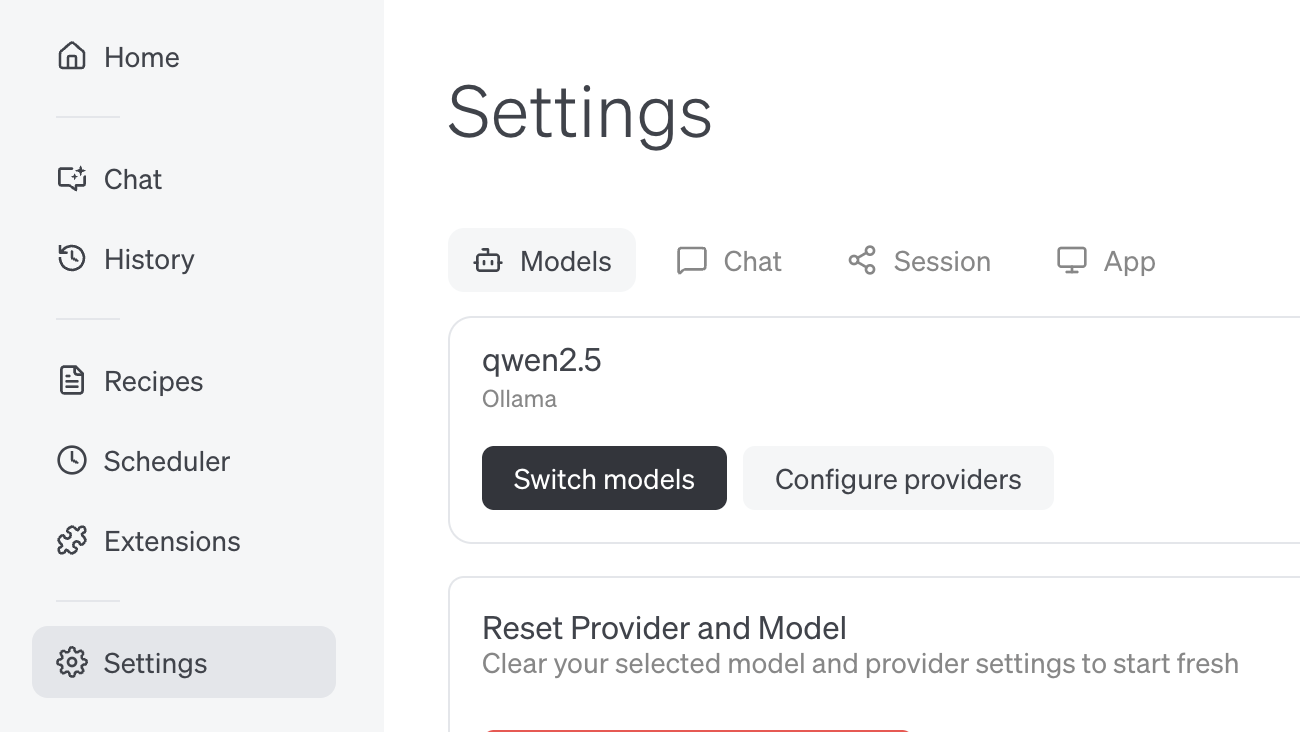
- Find Ollama, click Configure
- Confirm API Host is
http://localhost:11434and click Submit
Connecting to ollama.com
- Create an API key on ollama.com and save it in your
.env - In Goose, set API Host to
https://ollama.com
Goose CLI
Install Goose CLI
Usage with Ollama
- Run
goose configure - Select Configure Providers and select Ollama
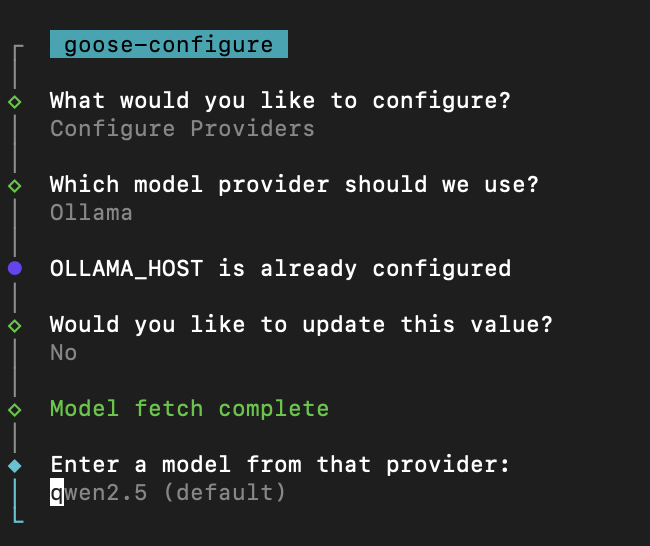
- Enter model name (e.g
qwen3)
Connecting to ollama.com
- Create an API key on ollama.com and save it in your
.env - Run
goose configure - Select Configure Providers and select Ollama
- Update OLLAMA_HOST to
https://ollama.com
JetBrains
Source: https://docs.ollama.com/integrations/jetbrains
This example uses IntelliJ; same steps apply to other JetBrains IDEs (e.g., PyCharm).
Install
Install IntelliJ.
Usage with Ollama
To use **Ollama**, you will need a [JetBrains AI Subscription](https://www.jetbrains.com/ai-ides/buy/?section=personal\&billing=yearly).- In Intellij, click the chat icon located in the right sidebar
- Select the current model in the sidebar, then click Set up Local Models
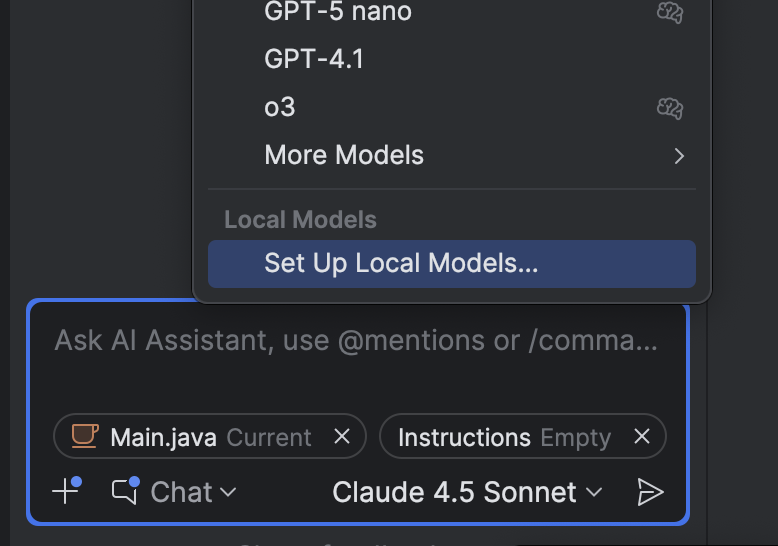
- Under Third Party AI Providers, choose Ollama
- Confirm the Host URL is
http://localhost:11434, then click Ok - Once connected, select a model under Local models by Ollama
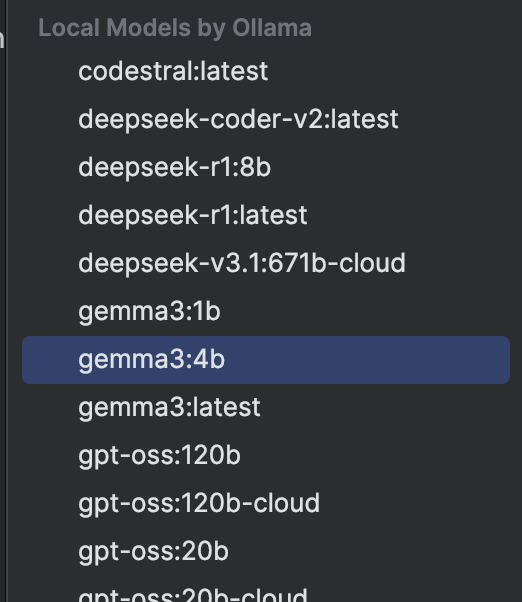
n8n
Source: https://docs.ollama.com/integrations/n8n
Install
Install n8n.
Using Ollama Locally
- In the top right corner, click the dropdown and select Create Credential
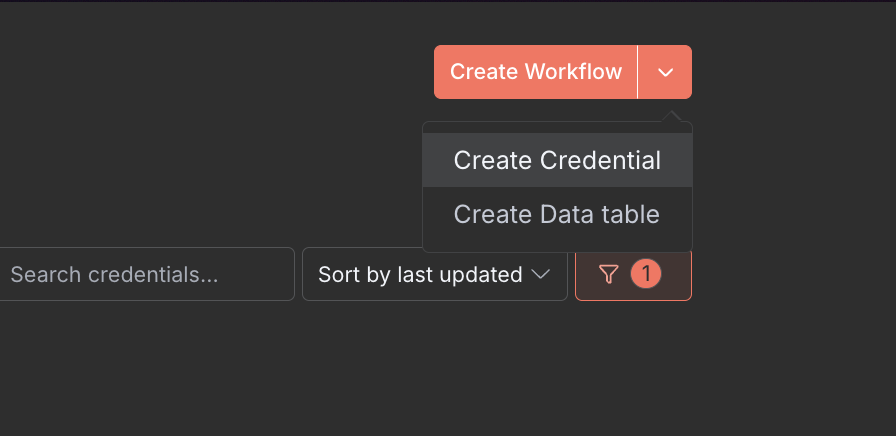
- Under Add new credential select Ollama
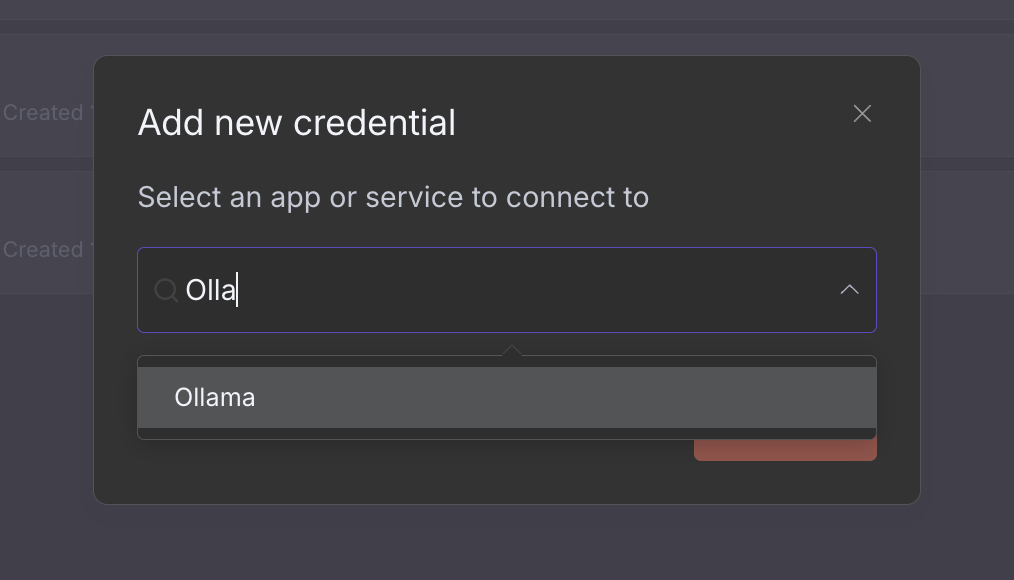
- Confirm Base URL is set to
http://localhost:11434and click Save If connecting tohttp://localhost:11434fails, usehttp://127.0.0.1:11434 - When creating a new workflow, select Add a first step and select an Ollama node
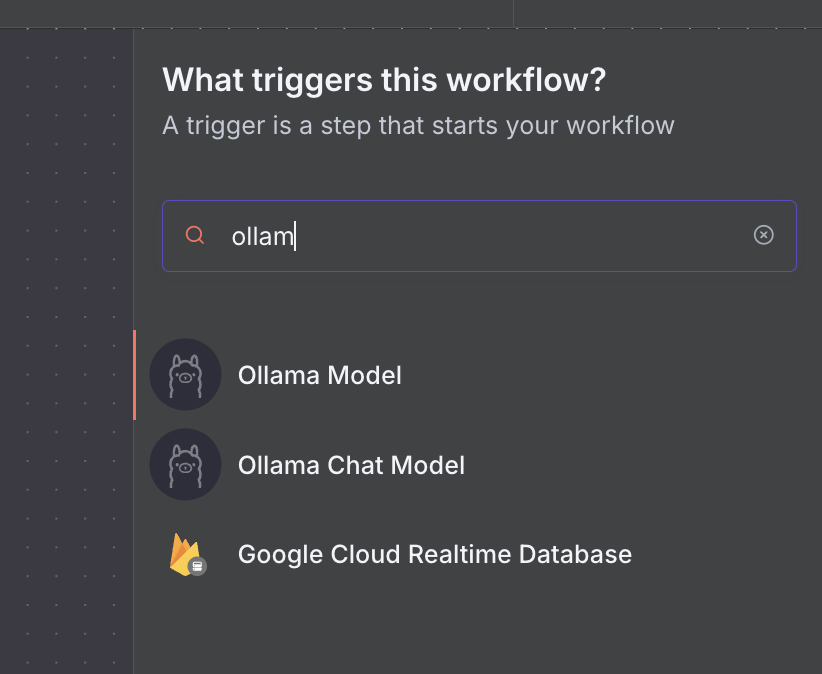
- Select your model of choice (e.g.
qwen3-coder)
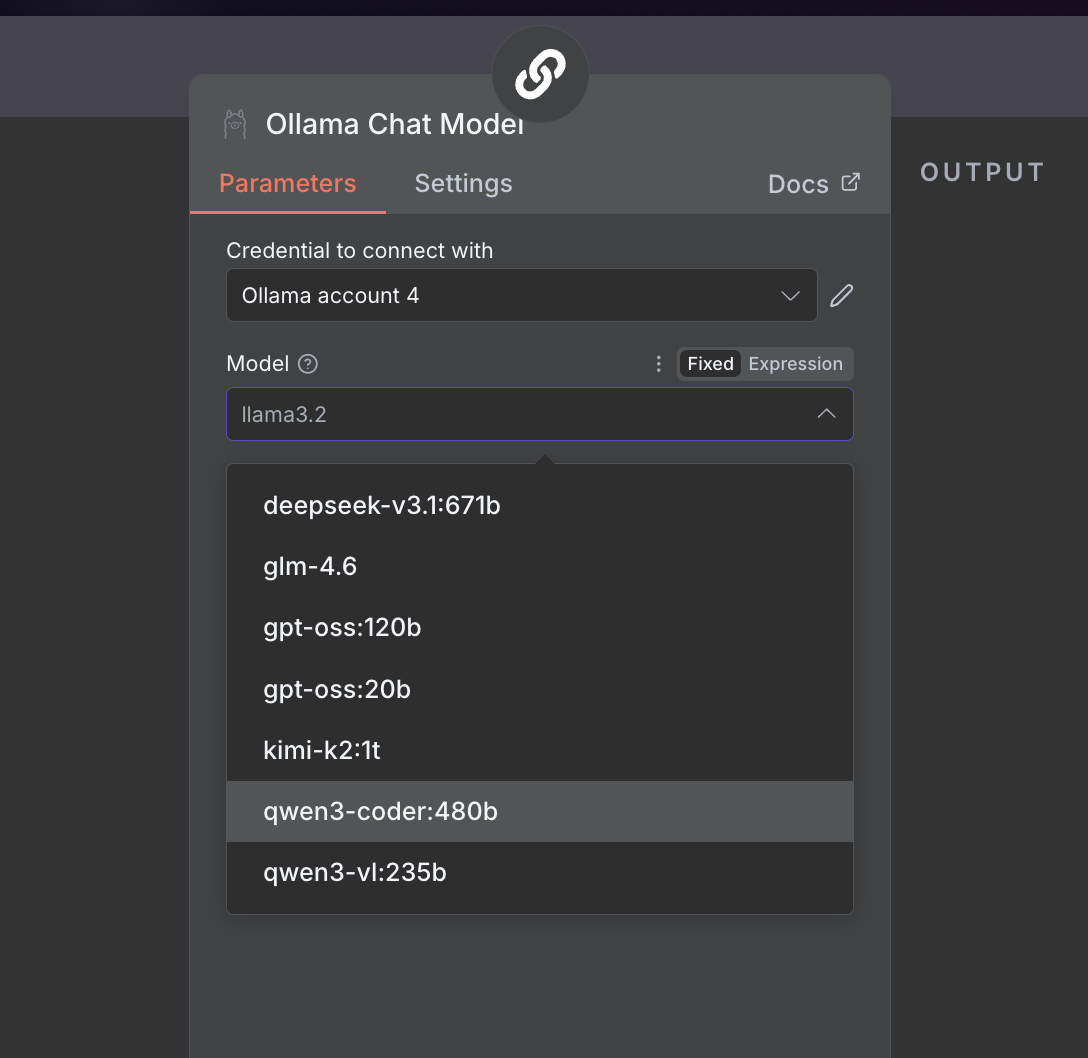
Connecting to ollama.com
- Create an API key on ollama.com.
- In n8n, click Create Credential and select Ollama
- Set the API URL to
https://ollama.com - Enter your API Key and click Save
Roo Code
Source: https://docs.ollama.com/integrations/roo-code
Install
Install Roo Code from the VS Code Marketplace.
Usage with Ollama
- Open Roo Code in VS Code and click the gear icon on the top right corner of the Roo Code window to open Provider Settings
- Set
API ProvidertoOllama - (Optional) Update
Base URLif your Ollama instance is running remotely. The default ishttp://localhost:11434 - Enter a valid
Model ID(for exampleqwen3orqwen3-coder:480b-cloud) - Adjust the
Context Windowto at least 32K tokens for coding tasks
Coding tools require a larger context window. It is recommended to use a context window of at least 32K tokens. See Context length for more information.
Connecting to ollama.com
- Create an API key from ollama.com
- Enable
Use custom base URLand set it tohttps://ollama.com - Enter your Ollama API Key
- Select a model from the list
Recommended Models
qwen3-coder:480bdeepseek-v3.1:671b
VS Code
Source: https://docs.ollama.com/integrations/vscode
Install
Install VSCode.
Usage with Ollama
- Open Copilot side bar found in top right window
- Select the model drowpdown > Manage models
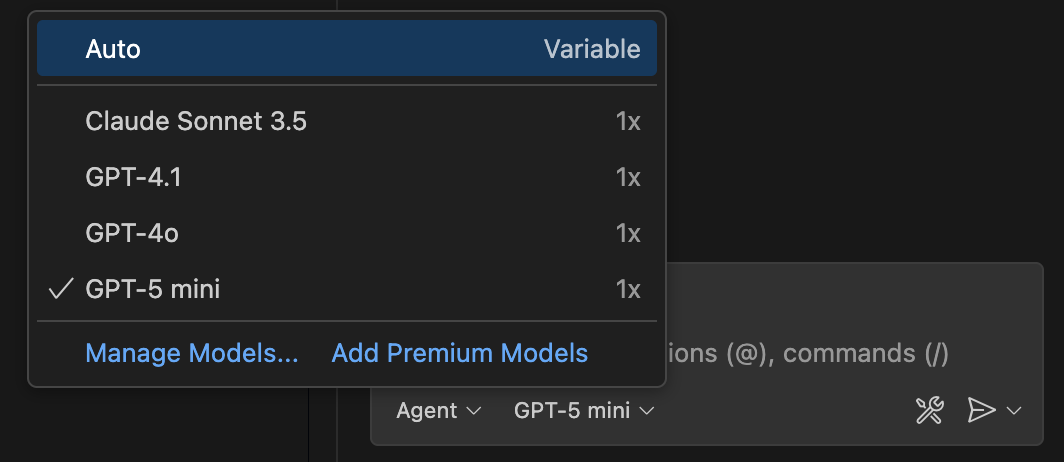
- Enter Ollama under Provider Dropdown and select desired models (e.g
qwen3, qwen3-coder:480b-cloud)
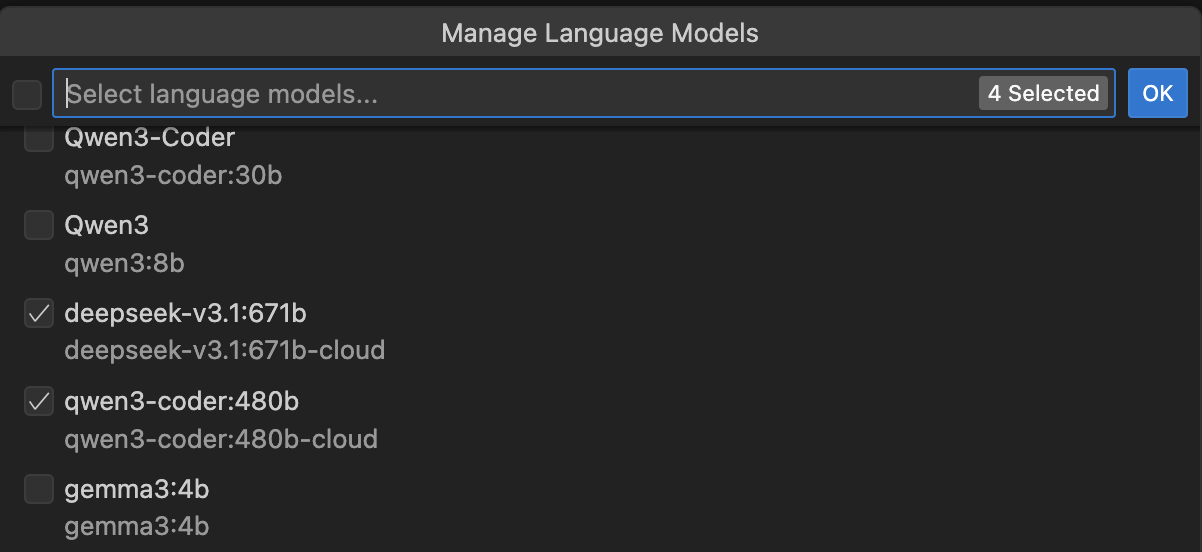
Xcode
Source: https://docs.ollama.com/integrations/xcode
Install
Install XCode
Usage with Ollama
Ensure Apple Intelligence is setup and the latest XCode version is v26.0
- Click XCode in top left corner > Settings
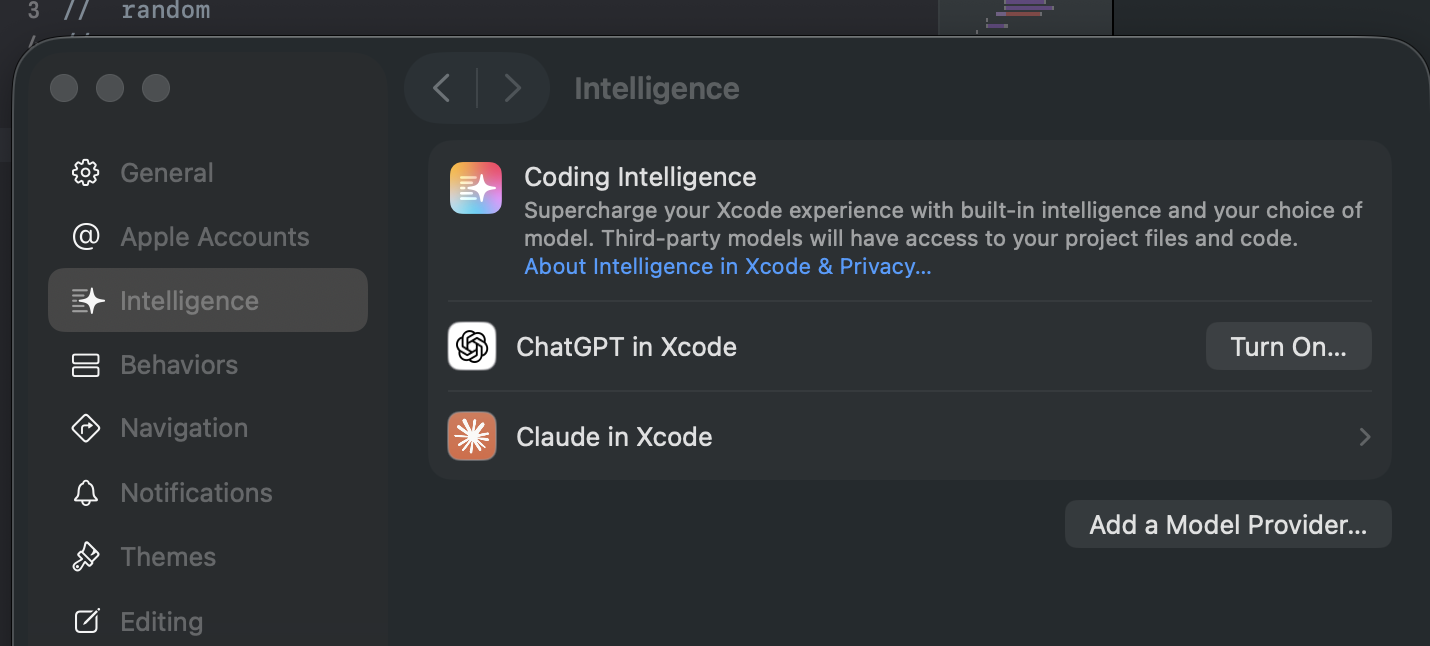
- Select Locally Hosted, enter port 11434 and click Add
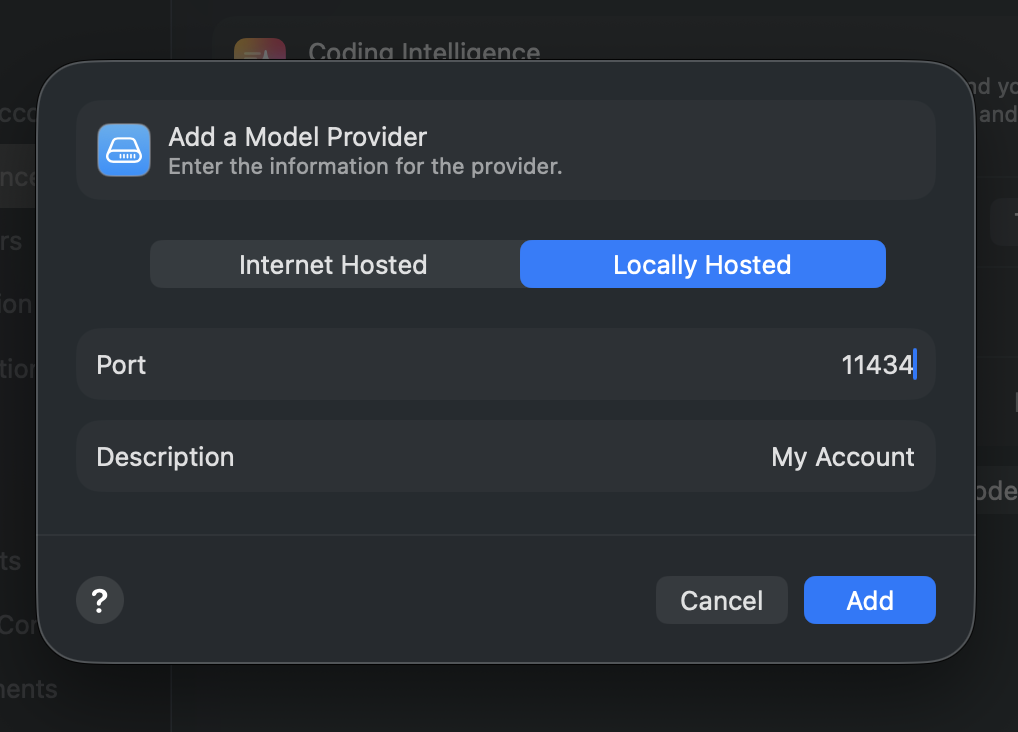
- Select the star icon on the top left corner and click the dropdown
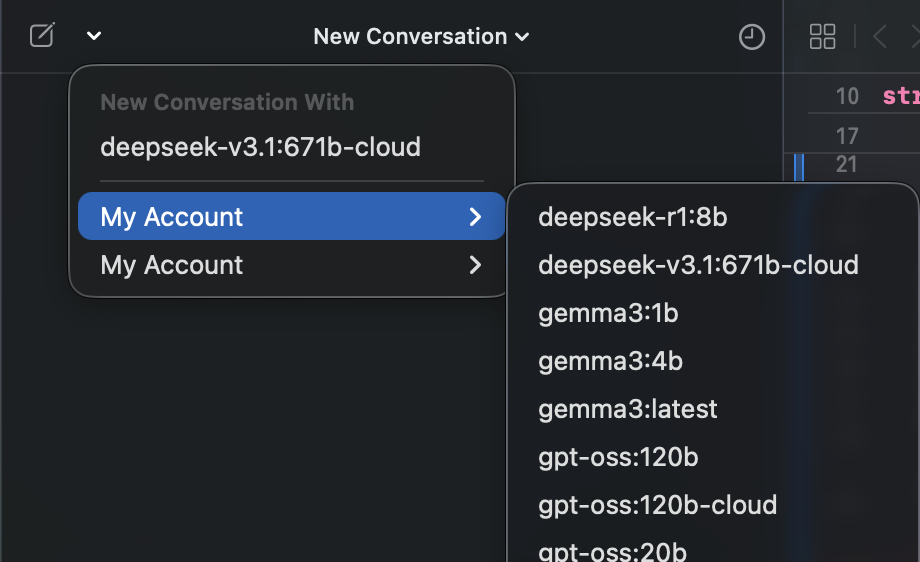
- Click My Account and select your desired model
Connecting to ollama.com directly
- Create an API key from ollama.com
- Select Internet Hosted and enter URL as
https://ollama.com - Enter your Ollama API Key and click Add
Zed
Source: https://docs.ollama.com/integrations/zed
Install
Install Zed.
Usage with Ollama
- In Zed, click the star icon in the bottom-right corner, then select Configure.
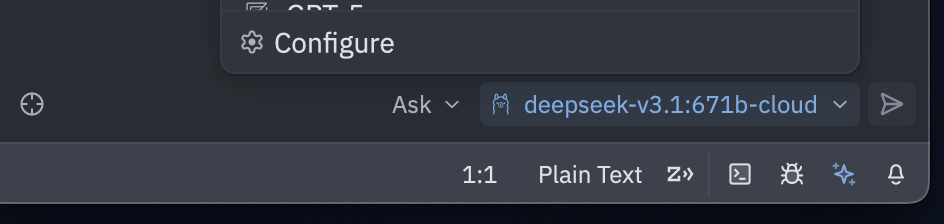
- Under LLM Providers, choose Ollama
- Confirm the Host URL is
http://localhost:11434, then click Connect - Once connected, select a model under Ollama
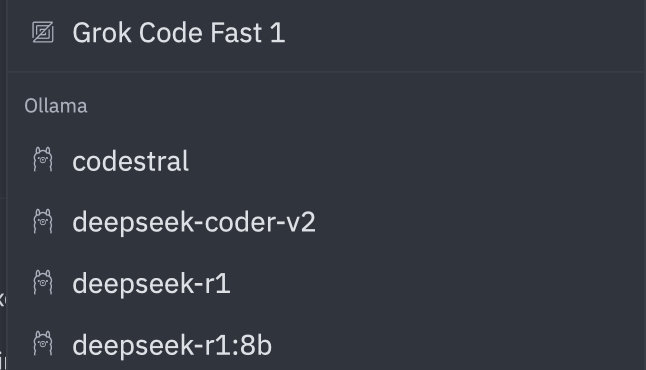
Connecting to ollama.com
- Create an API key on ollama.com
- In Zed, open the star icon → Configure
- Under LLM Providers, select Ollama
- Set the API URL to
https://ollama.com
Linux
Source: https://docs.ollama.com/linux
Install
To install Ollama, run the following command:
curl -fsSL https://ollama.com/install.sh | sh
Manual install
If you are upgrading from a prior version, you should remove the old libraries with `sudo rm -rf /usr/lib/ollama` first.Download and extract the package:
curl -fsSL https://ollama.com/download/ollama-linux-amd64.tgz \
    | sudo tar zx -C /usr
Start Ollama:
ollama serve
In another terminal, verify that Ollama is running:
ollama -v
AMD GPU install
If you have an AMD GPU, also download and extract the additional ROCm package:
curl -fsSL https://ollama.com/download/ollama-linux-amd64-rocm.tgz \
    | sudo tar zx -C /usr
ARM64 install
Download and extract the ARM64-specific package:
curl -fsSL https://ollama.com/download/ollama-linux-arm64.tgz \
    | sudo tar zx -C /usr
Adding Ollama as a startup service (recommended)
Create a user and group for Ollama:
sudo useradd -r -s /bin/false -U -m -d /usr/share/ollama ollama
sudo usermod -a -G ollama $(whoami)
Create a service file in /etc/systemd/system/ollama.service:
[Unit]
Description=Ollama Service
After=network-online.target

[Service]
ExecStart=/usr/bin/ollama serve
User=ollama
Group=ollama
Restart=always
RestartSec=3
Environment="PATH=$PATH"

[Install]
WantedBy=multi-user.target
Then start the service:
sudo systemctl daemon-reload
sudo systemctl enable ollama
Install CUDA drivers (optional)
Download and install CUDA.
Verify that the drivers are installed by running the following command, which should print details about your GPU:
nvidia-smi
Install AMD ROCm drivers (optional)
Download and Install ROCm v6.
Start Ollama
Start Ollama and verify it is running:
sudo systemctl start ollama
sudo systemctl status ollama
Customizing
To customize the installation of Ollama, you can edit the systemd service file or the environment variables by running:
sudo systemctl edit ollama
Alternatively, create an override file manually in /etc/systemd/system/ollama.service.d/override.conf:
[Service]
Environment="OLLAMA_DEBUG=1"
Updating
Update Ollama by running the install script again:
curl -fsSL https://ollama.com/install.sh | sh
Or by re-downloading Ollama:
curl -fsSL https://ollama.com/download/ollama-linux-amd64.tgz \
    | sudo tar zx -C /usr
Installing specific versions
Use OLLAMA_VERSION environment variable with the install script to install a specific version of Ollama, including pre-releases. You can find the version numbers in the releases page.
For example:
curl -fsSL https://ollama.com/install.sh | OLLAMA_VERSION=0.5.7 sh
Viewing logs
To view logs of Ollama running as a startup service, run:
journalctl -e -u ollama
Uninstall
Remove the ollama service:
sudo systemctl stop ollama
sudo systemctl disable ollama
sudo rm /etc/systemd/system/ollama.service
Remove ollama libraries from your lib directory (either /usr/local/lib, /usr/lib, or /lib):
sudo rm -r $(which ollama | tr 'bin' 'lib')
Remove the ollama binary from your bin directory (either /usr/local/bin, /usr/bin, or /bin):
sudo rm $(which ollama)
Remove the downloaded models and Ollama service user and group:
sudo userdel ollama
sudo groupdel ollama
sudo rm -r /usr/share/ollama
macOS
Source: https://docs.ollama.com/macos
System Requirements
- MacOS Sonoma (v14) or newer
- Apple M series (CPU and GPU support) or x86 (CPU only)
Filesystem Requirements
The preferred method of installation is to mount the ollama.dmg and drag-and-drop the Ollama application to the system-wide Applications folder. Upon startup, the Ollama app will verify the ollama CLI is present in your PATH, and if not detected, will prompt for permission to create a link in /usr/local/bin
Once you've installed Ollama, you'll need additional space for storing the Large Language models, which can be tens to hundreds of GB in size. If your home directory doesn't have enough space, you can change where the binaries are installed, and where the models are stored.
Changing Install Location
To install the Ollama application somewhere other than Applications, place the Ollama application in the desired location, and ensure the CLI Ollama.app/Contents/Resources/ollama or a sym-link to the CLI can be found in your path. Upon first start decline the "Move to Applications?" request.
Troubleshooting
Ollama on MacOS stores files in a few different locations.
~/.ollamacontains models and configuration~/.ollama/logscontains logs- app.log contains most recent logs from the GUI application
- server.log contains the most recent server logs
<install location>/Ollama.app/Contents/Resources/ollamathe CLI binary
Uninstall
To fully remove Ollama from your system, remove the following files and folders:
sudo rm -rf /Applications/Ollama.app
sudo rm /usr/local/bin/ollama
rm -rf "~/Library/Application Support/Ollama"
rm -rf "~/Library/Saved Application State/com.electron.ollama.savedState"
rm -rf ~/Library/Caches/com.electron.ollama/
rm -rf ~/Library/Caches/ollama
rm -rf ~/Library/WebKit/com.electron.ollama
rm -rf ~/.ollama
Modelfile Reference
Source: https://docs.ollama.com/modelfile
A Modelfile is the blueprint to create and share customized models using Ollama.
Table of Contents
Format
The format of the Modelfile:
# comment
INSTRUCTION arguments
| Instruction | Description |
|---|---|
FROM (required) |
Defines the base model to use. |
PARAMETER |
Sets the parameters for how Ollama will run the model. |
TEMPLATE |
The full prompt template to be sent to the model. |
SYSTEM |
Specifies the system message that will be set in the template. |
ADAPTER |
Defines the (Q)LoRA adapters to apply to the model. |
LICENSE |
Specifies the legal license. |
MESSAGE |
Specify message history. |
Examples
Basic Modelfile
An example of a Modelfile creating a mario blueprint:
FROM llama3.2
# sets the temperature to 1 [higher is more creative, lower is more coherent]
PARAMETER temperature 1
# sets the context window size to 4096, this controls how many tokens the LLM can use as context to generate the next token
PARAMETER num_ctx 4096

# sets a custom system message to specify the behavior of the chat assistant
SYSTEM You are Mario from super mario bros, acting as an assistant.
To use this:
- Save it as a file (e.g.
Modelfile) ollama create choose-a-model-name -f <location of the file e.g. ./Modelfile>ollama run choose-a-model-name- Start using the model!
To view the Modelfile of a given model, use the ollama show --modelfile command.
ollama show --modelfile llama3.2
# Modelfile generated by "ollama show"
# To build a new Modelfile based on this one, replace the FROM line with:
# FROM llama3.2:latest
FROM /Users/pdevine/.ollama/models/blobs/sha256-00e1317cbf74d901080d7100f57580ba8dd8de57203072dc6f668324ba545f29
TEMPLATE """{{ if .System }}<|start_header_id|>system<|end_header_id|>

{{ .System }}<|eot_id|>{{ end }}{{ if .Prompt }}<|start_header_id|>user<|end_header_id|>

{{ .Prompt }}<|eot_id|>{{ end }}<|start_header_id|>assistant<|end_header_id|>

{{ .Response }}<|eot_id|>"""
PARAMETER stop "<|start_header_id|>"
PARAMETER stop "<|end_header_id|>"
PARAMETER stop "<|eot_id|>"
PARAMETER stop "<|reserved_special_token"
Instructions
FROM (Required)
The FROM instruction defines the base model to use when creating a model.
FROM <model name>:<tag>
Build from existing model
FROM llama3.2
Build from a Safetensors model
FROM <model directory>
The model directory should contain the Safetensors weights for a supported architecture.
Currently supported model architectures:
- Llama (including Llama 2, Llama 3, Llama 3.1, and Llama 3.2)
- Mistral (including Mistral 1, Mistral 2, and Mixtral)
- Gemma (including Gemma 1 and Gemma 2)
- Phi3
Build from a GGUF file
FROM ./ollama-model.gguf
The GGUF file location should be specified as an absolute path or relative to the Modelfile location.
PARAMETER
The PARAMETER instruction defines a parameter that can be set when the model is run.
PARAMETER <parameter> <parametervalue>
Valid Parameters and Values
| Parameter | Description | Value Type | Example Usage |
|---|---|---|---|
| mirostat | Enable Mirostat sampling for controlling perplexity. (default: 0, 0 = disabled, 1 = Mirostat, 2 = Mirostat 2.0) | int | mirostat 0 |
| mirostat_eta | Influences how quickly the algorithm responds to feedback from the generated text. A lower learning rate will result in slower adjustments, while a higher learning rate will make the algorithm more responsive. (Default: 0.1) | float | mirostat_eta 0.1 |
| mirostat_tau | Controls the balance between coherence and diversity of the output. A lower value will result in more focused and coherent text. (Default: 5.0) | float | mirostat_tau 5.0 |
| num_ctx | Sets the size of the context window used to generate the next token. (Default: 2048) | int | num_ctx 4096 |
| repeat_last_n | Sets how far back for the model to look back to prevent repetition. (Default: 64, 0 = disabled, -1 = num_ctx) | int | repeat_last_n 64 |
| repeat_penalty | Sets how strongly to penalize repetitions. A higher value (e.g., 1.5) will penalize repetitions more strongly, while a lower value (e.g., 0.9) will be more lenient. (Default: 1.1) | float | repeat_penalty 1.1 |
| temperature | The temperature of the model. Increasing the temperature will make the model answer more creatively. (Default: 0.8) | float | temperature 0.7 |
| seed | Sets the random number seed to use for generation. Setting this to a specific number will make the model generate the same text for the same prompt. (Default: 0) | int | seed 42 |
| stop | Sets the stop sequences to use. When this pattern is encountered the LLM will stop generating text and return. Multiple stop patterns may be set by specifying multiple separate stop parameters in a modelfile. |
string | stop "AI assistant:" |
| num_predict | Maximum number of tokens to predict when generating text. (Default: -1, infinite generation) | int | num_predict 42 |
| top_k | Reduces the probability of generating nonsense. A higher value (e.g. 100) will give more diverse answers, while a lower value (e.g. 10) will be more conservative. (Default: 40) | int | top_k 40 |
| top_p | Works together with top-k. A higher value (e.g., 0.95) will lead to more diverse text, while a lower value (e.g., 0.5) will generate more focused and conservative text. (Default: 0.9) | float | top_p 0.9 |
| min_p | Alternative to the topp, and aims to ensure a balance of quality and variety. The parameter _p represents the minimum probability for a token to be considered, relative to the probability of the most likely token. For example, with p=0.05 and the most likely token having a probability of 0.9, logits with a value less than 0.045 are filtered out. (Default: 0.0) | float | min_p 0.05 |
TEMPLATE
TEMPLATE of the full prompt template to be passed into the model. It may include (optionally) a system message, a user's message and the response from the model. Note: syntax may be model specific. Templates use Go template syntax.
Template Variables
| Variable | Description |
|---|---|
{{ .System }} |
The system message used to specify custom behavior. |
{{ .Prompt }} |
The user prompt message. |
{{ .Response }} |
The response from the model. When generating a response, text after this variable is omitted. |
TEMPLATE """{{ if .System }}<|im_start|>system
{{ .System }}<|im_end|>
{{ end }}{{ if .Prompt }}<|im_start|>user
{{ .Prompt }}<|im_end|>
{{ end }}<|im_start|>assistant
"""
SYSTEM
The SYSTEM instruction specifies the system message to be used in the template, if applicable.
SYSTEM """<system message>"""
ADAPTER
The ADAPTER instruction specifies a fine tuned LoRA adapter that should apply to the base model. The value of the adapter should be an absolute path or a path relative to the Modelfile. The base model should be specified with a FROM instruction. If the base model is not the same as the base model that the adapter was tuned from the behaviour will be erratic.
Safetensor adapter
ADAPTER <path to safetensor adapter>
Currently supported Safetensor adapters:
- Llama (including Llama 2, Llama 3, and Llama 3.1)
- Mistral (including Mistral 1, Mistral 2, and Mixtral)
- Gemma (including Gemma 1 and Gemma 2)
GGUF adapter
ADAPTER ./ollama-lora.gguf
LICENSE
The LICENSE instruction allows you to specify the legal license under which the model used with this Modelfile is shared or distributed.
LICENSE """
<license text>
"""
MESSAGE
The MESSAGE instruction allows you to specify a message history for the model to use when responding. Use multiple iterations of the MESSAGE command to build up a conversation which will guide the model to answer in a similar way.
MESSAGE <role> <message>
Valid roles
| Role | Description |
|---|---|
| system | Alternate way of providing the SYSTEM message for the model. |
| user | An example message of what the user could have asked. |
| assistant | An example message of how the model should respond. |
Example conversation
MESSAGE user Is Toronto in Canada?
MESSAGE assistant yes
MESSAGE user Is Sacramento in Canada?
MESSAGE assistant no
MESSAGE user Is Ontario in Canada?
MESSAGE assistant yes
Notes
- the
Modelfileis not case sensitive. In the examples, uppercase instructions are used to make it easier to distinguish it from arguments. - Instructions can be in any order. In the examples, the
FROMinstruction is first to keep it easily readable.
Quickstart
Source: https://docs.ollama.com/quickstart
This quickstart will walk your through running your first model with Ollama. To get started, download Ollama on macOS, Windows or Linux.
Download OllamaRun a model
Open a terminal and run the command:```
ollama run gemma3
```
Lastly, chat with the model:

```shell  theme={"system"}
curl http://localhost:11434/api/chat -d '{
  "model": "gemma3",
  "messages": [{
    "role": "user",
    "content": "Hello there!"
  }],
  "stream": false
}'
```
```
ollama pull gemma3
```

Then install Ollama's Python library:

```
pip install ollama
```

Lastly, chat with the model:

```python  theme={"system"}
from ollama import chat
from ollama import ChatResponse

response: ChatResponse = chat(model='gemma3', messages=[
  {
    'role': 'user',
    'content': 'Why is the sky blue?',
  },
])
print(response['message']['content'])
# or access fields directly from the response object
print(response.message.content)
```
```
ollama pull gemma3
```

Then install the Ollama JavaScript library:

```
npm i ollama
```

Lastly, chat with the model:

```shell  theme={"system"}
import ollama from 'ollama'

const response = await ollama.chat({
  model: 'gemma3',
  messages: [{ role: 'user', content: 'Why is the sky blue?' }],
})
console.log(response.message.content)
```
See a full list of available models here.
Troubleshooting
Source: https://docs.ollama.com/troubleshooting
How to troubleshoot issues encountered with Ollama
Sometimes Ollama may not perform as expected. One of the best ways to figure out what happened is to take a look at the logs. Find the logs on Mac by running the command:
cat ~/.ollama/logs/server.log
On Linux systems with systemd, the logs can be found with this command:
journalctl -u ollama --no-pager --follow --pager-end
When you run Ollama in a container, the logs go to stdout/stderr in the container:
docker logs <container-name>
(Use docker ps to find the container name)
If manually running ollama serve in a terminal, the logs will be on that terminal.
When you run Ollama on Windows, there are a few different locations. You can view them in the explorer window by hitting <cmd>+R and type in:
explorer %LOCALAPPDATA%\Ollamato view logs. The most recent server logs will be inserver.logand older logs will be inserver-#.logexplorer %LOCALAPPDATA%\Programs\Ollamato browse the binaries (The installer adds this to your user PATH)explorer %HOMEPATH%\.ollamato browse where models and configuration is storedexplorer %TEMP%where temporary executable files are stored in one or moreollama*directories
To enable additional debug logging to help troubleshoot problems, first Quit the running app from the tray menu then in a powershell terminal
$env:OLLAMA_DEBUG="1"
& "ollama app.exe"
Join the Discord for help interpreting the logs.
LLM libraries
Ollama includes multiple LLM libraries compiled for different GPUs and CPU vector features. Ollama tries to pick the best one based on the capabilities of your system. If this autodetection has problems, or you run into other problems (e.g. crashes in your GPU) you can workaround this by forcing a specific LLM library. cpu_avx2 will perform the best, followed by cpu_avx an the slowest but most compatible is cpu. Rosetta emulation under MacOS will work with the cpu library.
In the server log, you will see a message that looks something like this (varies from release to release):
Dynamic LLM libraries [rocm_v6 cpu cpu_avx cpu_avx2 cuda_v11 rocm_v5]
Experimental LLM Library Override
You can set OLLAMA_LLM_LIBRARY to any of the available LLM libraries to bypass autodetection, so for example, if you have a CUDA card, but want to force the CPU LLM library with AVX2 vector support, use:
OLLAMA_LLM_LIBRARY="cpu_avx2" ollama serve
You can see what features your CPU has with the following.
cat /proc/cpuinfo| grep flags | head -1
Installing older or pre-release versions on Linux
If you run into problems on Linux and want to install an older version, or you'd like to try out a pre-release before it's officially released, you can tell the install script which version to install.
curl -fsSL https://ollama.com/install.sh | OLLAMA_VERSION=0.5.7 sh
Linux tmp noexec
If your system is configured with the "noexec" flag where Ollama stores its temporary executable files, you can specify an alternate location by setting OLLAMA_TMPDIR to a location writable by the user ollama runs as. For example OLLAMA_TMPDIR=/usr/share/ollama/
Linux docker
If Ollama initially works on the GPU in a docker container, but then switches to running on CPU after some period of time with errors in the server log reporting GPU discovery failures, this can be resolved by disabling systemd cgroup management in Docker. Edit /etc/docker/daemon.json on the host and add "exec-opts": ["native.cgroupdriver=cgroupfs"] to the docker configuration.
NVIDIA GPU Discovery
When Ollama starts up, it takes inventory of the GPUs present in the system to determine compatibility and how much VRAM is available. Sometimes this discovery can fail to find your GPUs. In general, running the latest driver will yield the best results.
Linux NVIDIA Troubleshooting
If you are using a container to run Ollama, make sure you've set up the container runtime first as described in docker.md
Sometimes the Ollama can have difficulties initializing the GPU. When you check the server logs, this can show up as various error codes, such as "3" (not initialized), "46" (device unavailable), "100" (no device), "999" (unknown), or others. The following troubleshooting techniques may help resolve the problem
- If you are using a container, is the container runtime working? Try
docker run --gpus all ubuntu nvidia-smi- if this doesn't work, Ollama won't be able to see your NVIDIA GPU. - Is the uvm driver loaded?
sudo nvidia-modprobe -u - Try reloading the nvidia_uvm driver -
sudo rmmod nvidia_uvmthensudo modprobe nvidia_uvm - Try rebooting
- Make sure you're running the latest nvidia drivers
If none of those resolve the problem, gather additional information and file an issue:
- Set
CUDA_ERROR_LEVEL=50and try again to get more diagnostic logs - Check dmesg for any errors
sudo dmesg | grep -i nvrmandsudo dmesg | grep -i nvidia
AMD GPU Discovery
On linux, AMD GPU access typically requires video and/or render group membership to access the /dev/kfd device. If permissions are not set up correctly, Ollama will detect this and report an error in the server log.
When running in a container, in some Linux distributions and container runtimes, the ollama process may be unable to access the GPU. Use ls -lnd /dev/kfd /dev/dri /dev/dri/* on the host system to determine the numeric group IDs on your system, and pass additional --group-add ... arguments to the container so it can access the required devices. For example, in the following output crw-rw---- 1 0 44 226, 0 Sep 16 16:55 /dev/dri/card0 the group ID column is 44
If you are experiencing problems getting Ollama to correctly discover or use your GPU for inference, the following may help isolate the failure.
AMD_LOG_LEVEL=3Enable info log levels in the AMD HIP/ROCm libraries. This can help show more detailed error codes that can help troubleshoot problemsOLLAMA_DEBUG=1During GPU discovery additional information will be reported- Check dmesg for any errors from amdgpu or kfd drivers
sudo dmesg | grep -i amdgpuandsudo dmesg | grep -i kfd
Multiple AMD GPUs
If you experience gibberish responses when models load across multiple AMD GPUs on Linux, see the following guide.
Windows Terminal Errors
Older versions of Windows 10 (e.g., 21H1) are known to have a bug where the standard terminal program does not display control characters correctly. This can result in a long string of strings like ←[?25h←[?25l being displayed, sometimes erroring with The parameter is incorrect To resolve this problem, please update to Win 10 22H1 or newer.
Windows
Source: https://docs.ollama.com/windows
Ollama runs as a native Windows application, including NVIDIA and AMD Radeon GPU support.
After installing Ollama for Windows, Ollama will run in the background and
the ollama command line is available in cmd, powershell or your favorite
terminal application. As usual the Ollama API will be served on
http://localhost:11434.
System Requirements
- Windows 10 22H2 or newer, Home or Pro
- NVIDIA 452.39 or newer Drivers if you have an NVIDIA card
- AMD Radeon Driver https://www.amd.com/en/support if you have a Radeon card
Ollama uses unicode characters for progress indication, which may render as unknown squares in some older terminal fonts in Windows 10. If you see this, try changing your terminal font settings.
Filesystem Requirements
The Ollama install does not require Administrator, and installs in your home directory by default. You'll need at least 4GB of space for the binary install. Once you've installed Ollama, you'll need additional space for storing the Large Language models, which can be tens to hundreds of GB in size. If your home directory doesn't have enough space, you can change where the binaries are installed, and where the models are stored.
Changing Install Location
To install the Ollama application in a location different than your home directory, start the installer with the following flag
OllamaSetup.exe /DIR="d:\some\location"
Changing Model Location
To change where Ollama stores the downloaded models instead of using your home directory, set the environment variable OLLAMA_MODELS in your user account.
-
Start the Settings (Windows 11) or Control Panel (Windows 10) application and search for environment variables.
-
Click on Edit environment variables for your account.
-
Edit or create a new variable for your user account for
OLLAMA_MODELSwhere you want the models stored -
Click OK/Apply to save.
If Ollama is already running, Quit the tray application and relaunch it from the Start menu, or a new terminal started after you saved the environment variables.
API Access
Here's a quick example showing API access from powershell
(Invoke-WebRequest -method POST -Body '{"model":"llama3.2", "prompt":"Why is the sky blue?", "stream": false}' -uri http://localhost:11434/api/generate ).Content | ConvertFrom-json
Troubleshooting
Ollama on Windows stores files in a few different locations. You can view them in
the explorer window by hitting <Ctrl>+R and type in:
explorer %LOCALAPPDATA%\Ollamacontains logs, and downloaded updates- app.log contains most resent logs from the GUI application
- server.log contains the most recent server logs
- upgrade.log contains log output for upgrades
explorer %LOCALAPPDATA%\Programs\Ollamacontains the binaries (The installer adds this to your user PATH)explorer %HOMEPATH%\.ollamacontains models and configurationexplorer %TEMP%contains temporary executable files in one or moreollama*directories
Uninstall
The Ollama Windows installer registers an Uninstaller application. Under Add or remove programs in Windows Settings, you can uninstall Ollama.
Standalone CLI
The easiest way to install Ollama on Windows is to use the OllamaSetup.exe
installer. It installs in your account without requiring Administrator rights.
We update Ollama regularly to support the latest models, and this installer will
help you keep up to date.
If you'd like to install or integrate Ollama as a service, a standalone
ollama-windows-amd64.zip zip file is available containing only the Ollama CLI
and GPU library dependencies for Nvidia. If you have an AMD GPU, also download
and extract the additional ROCm package ollama-windows-amd64-rocm.zip into the
same directory. This allows for embedding Ollama in existing applications, or
running it as a system service via ollama serve with tools such as
NSSM.